
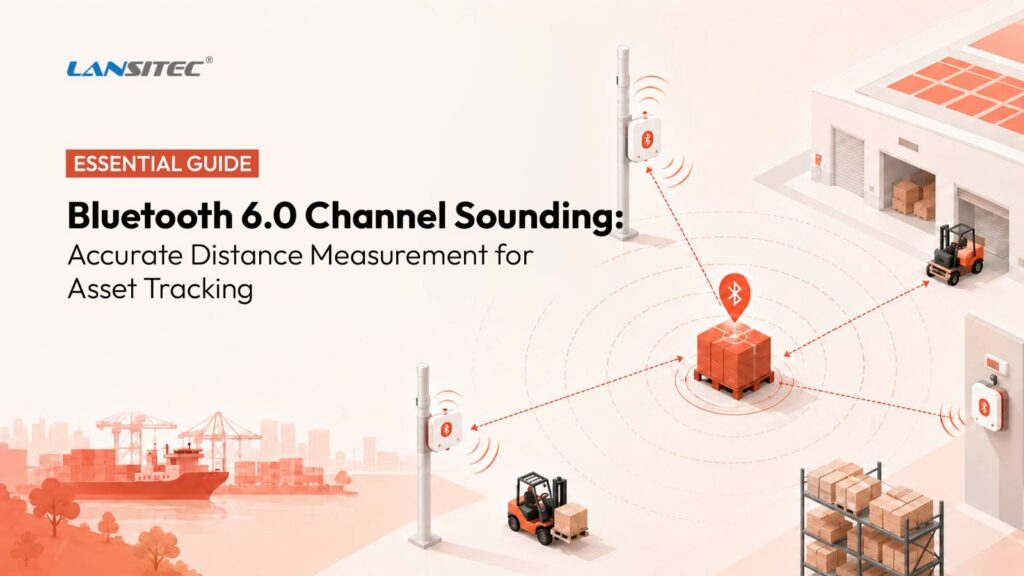
What Is Bluetooth 6.0 Channel Sounding?
Bluetooth asset tracking has evolved in layers.
بلوتوث 5.0 improved the radio foundation. بلوتوث 5.1 added signal direction. بلوتوث 5.4 made large-scale, bidirectional communication more practical. Then Bluetooth Core 6.0 introduced Channel Sounding, a standardized method for measuring the distance between two بلوتوث منخفض الطاقة الأجهزة.
Until بلوتوث 6.0, most conventional BLE proximity systems estimated distance from the received signal strength (RSSI). It works, and we use it widely, but walls, metal racks, people, machinery, antenna orientation, and multipath propagation can all change RSSI without the tracked asset moving. (1)
Channel Sounding does not simply produce a “better RSSI.” It measures properties of the radio channel itself, including phase and timing, to support significantly more accurate ranging. (1)(2)
Bluetooth 5.0 vs 5.1 vs 5.4 vs 6.0: What’s Changed for Asset Tracking?
| Bluetooth version | Important tracking feature | What it contributes |
|---|---|---|
| بلوتوث 5.0 | LE Coded PHY, LE 2M, Extended Advertising | Better range options, higher data rates, larger advertising payloads, and improved reliability in busy radio environments. (5) |
| بلوتوث 5.1 | Direction Finding with AoA and AoD | Determines the direction from which a signal arrives or departs. (4) |
| بلوتوث 5.4 | PAwR and Encrypted Advertising Data | Supports scalable bidirectional communication and standardized protection for advertising data.(3) |
| بلوتوث 6.0 | Channel Sounding | Adds fine ranging based on phase and round-trip timing.(1)(2) |
These features solve different problems. Newer does not automatically mean better for every deployment. More importantly, a product labeled with a particular Bluetooth Core version does not necessarily implement every optional feature included in that version.
Bluetooth 5.0 Features for Asset Tracking
بلوتوث 5.0 introduced three changes that remain highly relevant to tracking systems.
The first was LE Coded PHY, which applies forward error correction to improve receiver performance and extend usable communication range without simply increasing transmit power. Depending on the coding scheme, Bluetooth SIG documentation describes approximate range multipliers of two or four compared with LE 1M, although the actual result still depends on antennas, receiver sensitivity, transmit power, interference, and the physical environment. (5)
The second was LE 2M, which doubled the physical-layer symbol rate. Higher speed does not directly improve positioning accuracy, but it lets compatible devices exchange data more quickly and spend less time transmitting.
بلوتوث 5.0 also introduced Extended Advertising. Instead of carrying application data only through the three primary advertising channels, extended advertising can use secondary channels across the Bluetooth LE spectrum. This improves scalability and reduces exposure to packet collisions in crowded 2.4 GHz environments.
For asset tracking, these improvements created a more flexible radio link. A designer could prioritize range, speed, advertising capacity, or power consumption according to the use case.
Many current بوابات لانسيتك و المتتبعون continue to use بلوتوث 5.0 because these capabilities remain perfectly suitable for beacon collection, كشف الوجود, sensor data forwarding, and RSSI-based zone tracking.(6)
Bluetooth 5.1 AoA: How Direction Finding Works
بلوتوث 5.1 introduced Direction Finding through two methods:
- Angle of Arrival, or AoA
- Angle of Departure, or AoD
Direction Finding uses phase measurements collected from a Constant Tone Extension in the Bluetooth signal. With AoA, a receiver equipped with an antenna array measures how the signal reaches its individual antennas. It can then estimate the transmitting tag’s direction. (4)
That distinction is important: AoA determines an angle, not a direct point-to-point distance.
أ نظام تحديد المواقع can combine the calculated angle with the known location and installation height of the gateway to estimate a tag’s position. Multiple بوابات can improve coverage and confidence, especially when machinery, walls, or shelving obstruct the direct signal path.
In practice, AoA can deliver much better positioning than ordinary RSSI triangulation, but it comes with infrastructure requirements. The gateway needs a calibrated antenna array, a stable mounting position, suitable height, and careful map alignment. Move the gateway slightly and the calculated position may move with it, even though the tag has stayed put.
بلوتوث 5.1 therefore changed the type of information a tracking system could obtain. بلوتوث 5.0 helped devices communicate over a useful range. بلوتوث 5.1 helped determine where a signal was coming from. (4)
Bluetooth 5.4 Features for Large-Scale Asset Tracking
بلوتوث 5.4 did not introduce a new ranging method. Its main value for tracking lies in how devices exchange data.
How Bluetooth 6.0 Channel Sounding Measures Distance
Periodic Advertising with Responses, usually shortened to PAwR, creates energy-efficient, bidirectional, connectionless communication in large one-to-many networks. (3)
A broadcaster divides communication into scheduled events, subevents, and response slots. Receiving devices synchronize with the relevant subevent rather than continuously scanning. They can then send a response in an allocated slot without maintaining a conventional connection with the broadcaster.
This structure can help networks coordinate large numbers of tags, labels, أجهزة الاستشعار, or controllers. It is especially useful when one central device must distribute information and collect short responses from many battery-powered endpoints.
PAwR should not be described as a direct range enhancement. Its strengths are scheduling, scalability, bidirectional connectionless communication, and energy efficiency.
How Round-Trip Timing Works
RTT measures how long it takes for a packet to travel from the Initiator to the Reflector and back.
The Initiator records the packet’s time of departure and the response’s time of arrival. The procedure also accounts for the Reflector’s turnaround time, which is necessary for a meaningful time-of-flight calculation.
RTT provides a second distance estimate. The application can compare the RTT and PBR results, improving confidence and helping identify suspicious or inconsistent measurements. (1)(2)
How Accurate Is Bluetooth Channel Sounding?
Bluetooth SIG describes Channel Sounding as a centimeter-level ranging technology. In this context, “centimeter-level” means errors measured in tens of centimeters, not guaranteed one-centimeter precision. (2)
Early implementations have demonstrated approximately ±20 cm accuracy. Bluetooth SIG also states that measurements at distances up to 150 meters may be possible when both devices can transmit at the maximum permitted power. These are capability indicators, not universal field-performance guarantees.
Real-world results will still depend on:
- Radio design and antenna placement
- Line-of-sight conditions and multipath
- Ranging configuration and measurement algorithm
- Device movement, orientation, and environmental interference
Channel Sounding is more resistant to environmental effects than ordinary path-loss ranging, but factories have not suddenly become easy radio environments.
Bluetooth Ranging vs Positioning: What’s the Difference?
Channel Sounding calculates the distance between two devices. It does not automatically produce an X-Y coordinate on a warehouse map.
A single distance measurement tells the system how far apart two devices are, but not the exact direction from one to the other. In map terms, the tracked device could be anywhere along a circle around the known reference point.
That measurement can still answer valuable operational questions:
- Is this tool less than one meter from the authorized operator?
- Has the pallet reached the loading gate?
- Is the key fob genuinely close enough to unlock the cabinet?
- Which nearby asset is the user approaching?
To calculate a two-dimensional position, a system will generally need distance measurements from multiple known reference points, direction information, motion data, or another positioning method.
This is where hybrid designs become interesting. RSSI can provide low-power discovery and rough presence. Bluetooth Direction Finding can supply angle. Channel Sounding can add precise distance when the devices are close enough or when the application needs higher confidence.
Bluetooth SIG explicitly supports using Channel Sounding alongside RSSI and Direction Finding. (2)
Bluetooth 6.0 Security Features for Distance Measurement
Accurate distance matters for more than locating a pallet. Digital locks, vehicle access systems, protected machinery, and restricted-area controls must know that a trusted device is physically nearby. A relay attacker may try to make a remote credential appear closer than it really is.
Bluetooth Channel Sounding includes several countermeasures, including:
- Cross-checking PBR and RTT results
- Randomized transmission patterns and bit sequences
- Protection against radio-symbol manipulation
- A standardized attack-detection metric
The procedure also starts from an encrypted ACL connection used to exchange Channel Sounding control information. (1)
These measures do not remove the need for application-level security, but they make Channel Sounding suitable for use cases where proximity must be measured rather than merely assumed.
Bluetooth 6.0 vs UWB vs Bluetooth AoA: Which Is Best?
No. It expands the design options. بلوتوث 5.0 remains practical for beacon-based كشف الوجود, room-level tracking, sensor collection, and low-cost gateway deployments. بلوتوث 5.1 AoA remains valuable when the system needs direction and supports calibrated antenna-array بوابات. بلوتوث 5.4 improves communication with large groups of devices.
Channel Sounding is attractive when the application needs accurate point-to-point distance measurement and both devices can support the feature.
It may reduce the need for a separate ranging radio in some منتجات, particularly digital keys, smart locks, Find My devices, access control, and fine-proximity applications. It will not automatically replace النطاق العريض للغاية in every high-precision RTLS deployment. النطاق العريض للغاية still has a mature role in applications built specifically around rapid, centimeter-level positioning across defined anchor networks.
There is also a hardware consideration. Channel Sounding introduces new controller and physical-layer requirements. Some existing منتجات may support it through upgrades, but others will require a new Bluetooth LE integrated circuit. (2)
أ بلوتوث 5.0 gateway should not be assumed to gain Channel Sounding through a routine firmware update.
How to Choose the Right Bluetooth Tracking Technology
The version number is only the beginning. Before selecting tracking hardware, ask what the system actually needs to measure.
Do you need room presence, direction, distance, or complete map coordinates? How quickly should the position update? What level of error is acceptable? Must the system work through walls, around metal racks, or in open outdoor areas? And what will frequent ranging do to tag battery life?
We have seen projects become unnecessarily expensive because “high accuracy” was specified before anyone defined the operational decision that the location data needed to support.
بلوتوث 6.0 Channel Sounding is a major step because it gives Bluetooth devices standardized distance awareness. Still, the best tracking architecture may combine several generations and methods. بلوتوث 5.0 can handle efficient communication and discovery, بلوتوث 5.1 can determine direction, بلوتوث 5.4 can coordinate large device populations, and بلوتوث 6.0 can add fine ranging where it genuinely creates value.
That is the real evolution. Not one version replacing another, but a growing toolbox for building tracking systems around the accuracy, infrastructure, battery life, and security the application actually requires.
المراجع ومصادر القراءة الإضافية:
- Bluetooth SIG, Bluetooth Core 6.0 Feature Overview
- Bluetooth SIG, تشغيل قنوات البلوتوث
- Bluetooth SIG, Bluetooth Core 5.4 Technical Overview
- Bluetooth SIG, Enhancing Bluetooth Location Services with Direction Finding
- Bluetooth SIG, Bluetooth Core 5.0 Feature Enhancements
 English
  ไทย
ไทย  한국어
한국어  Français
  Deutsch
  Español
  日本語
日本語  العربية
  Italiano
  Português