
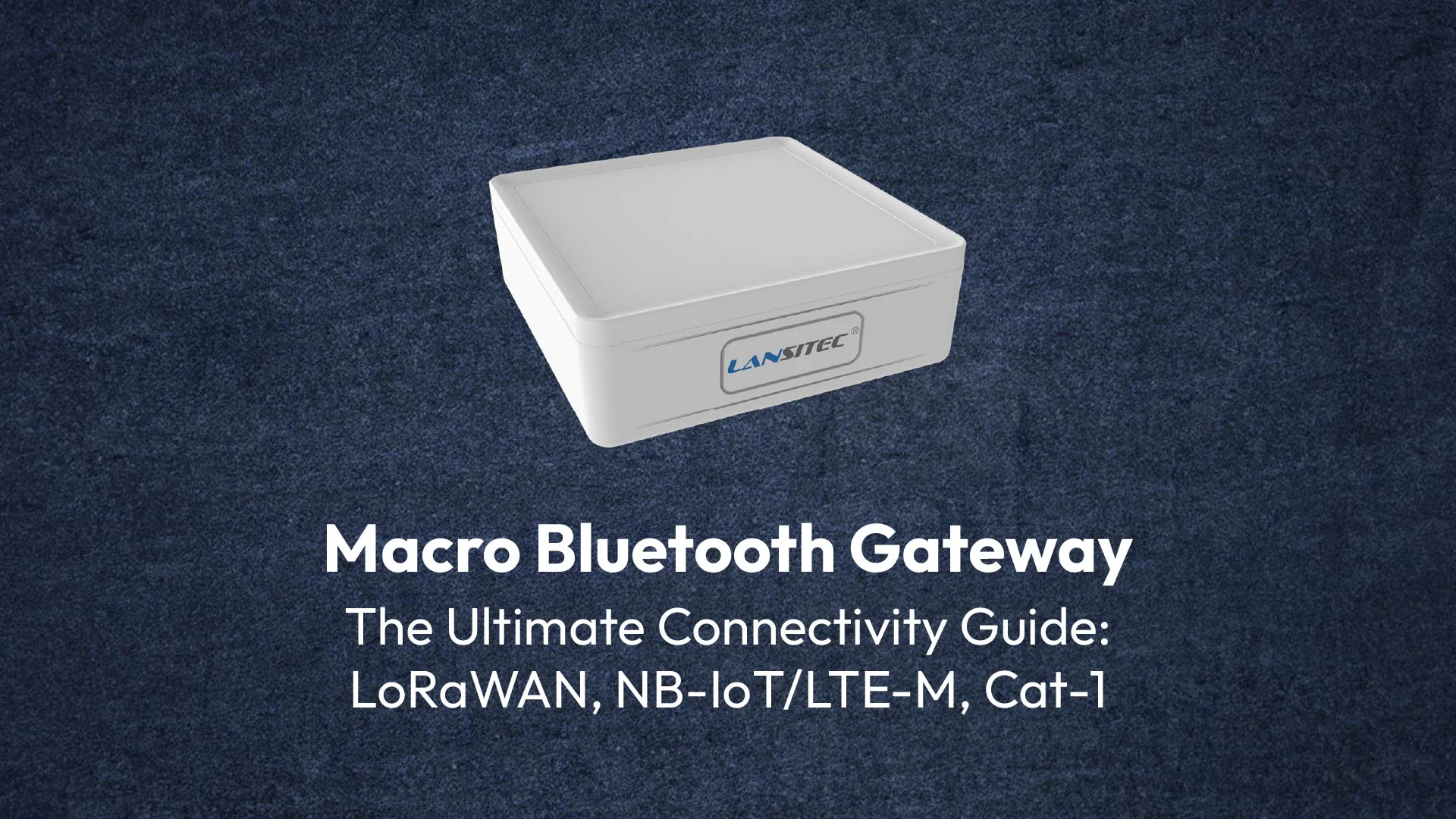
When customers first skim the data sheet of the Lansitec’s Macro Bluetooth Gateway, they often stumble over an apparent paradox. The device is called a gateway, yet the LoRaWAN version seems to rely on another LoRaWAN gateway in the vicinity. The moment you understand why, the rest of the product range falls neatly into place.
La macro Lansitec Puerta de enlace Bluetooth always performs the same local job: it listens to nearby BLE balizas, reshapes the payload, and sends it northbound. What changes between the three SKUs is how that uplink reaches the internet.
What is a Macro Bluetooth Gateway?
In the LoRaWAN ecosystem, the Macro Puerta de enlace Bluetooth plays the role of a LoRaWAN end-device, not a base-station. But this does not mean it is not a gateway.
How a Macro Bluetooth Gateway Works
It scans nearby BLE balizas, repackages their data, and then emits that data over its own LoRa radio. The catalog phrases this clearly: the Macro “forwards it to LoRaWAN puertas de enlace for real-time monitoring” and “transmit … BLE sensor readings to LoRaWAN gateways”.
How LoRaWAN Bluetooth Gateway Work
LoRaWAN uses a estrella de estrellas topology:
- End-devices (sensores, trackers… or this Macro) talk via LoRa.
- One or more LoRaWAN puertas de enlace (a.k.a. base stations) simply listen, de-duplicate, and relay those RF packets over IP (Ethernet, cellular, Wi-Fi) to a Network Server.
- The server handles security, deduplication, and forwards the data to your application.
End-devices cannot forward each other’s traffic and have no IP backhaul of their own, so at least one true LoRaWAN gateway must be within RF range to pass the macros’ uplinks onward.
Why is the Bluetooth Gateway Naming Confusing?
Lansitec calls the product a “Bluetooth Gateway” because it bridges Bluetooth ➜ LoRaWAN. In LoRaWAN terminology, though, it’s just another node. The “real” LoRaWAN gateway is the larger box (often on a mast or rooftop) with both a LoRa concentrator and an IP connection.
When You Don’t Need a Separate LoRaWAN Gateway
If your site already sits under public LoRaWAN coverage (e.g., a Helium hotspot or a carrier-operated gateway) and the Macro’s 22–30 dBm radio can reach it, you’re done. Otherwise, you’ll deploy an indoor/outdoor LoRaWAN gateway of your own and point it at The Things Stack, ChirpStack, etc.
Think of the Macro as a talkative sensor: fantastic at gathering BLE traffic, but it still needs a “tower” to shout to the cloud for it.
Bluetooth Gateway Network Topologies: LoRaWAN vs Cellular
So, the balizas talk to the gateway via BLE, then the gateway talks to another gateway via LoRaWAN, and then that other gateway connects the data to the network server where it can be used, correct? And for the other variants, can they directly transmit the data to the NS? Don’t they also need a device in the middle?
LoRaWAN vs NB-IoT/LTE-M vs Cat-1: The Short Answer
- LoRaWAN model — an end-device in disguise. In the LoRa universe, the Macro behaves like any other sensor. It transmits pure LoRa modulation and never speaks IP. A full LoRaWAN base-station (the “tower” with Ethernet, Wi-Fi, or cellular back-haul) must be in range to forward those packets to your Network Server. No base-station, no cloud data.
- NB-IoT/LTE-M and Cat-1 models — the modem is already inside. These siblings carry a 3GPP radio, a SIM/eSIM, and an IP stack. They attach directly to the nearest mobile tower and deliver MQTT or HTTPS traffic end-to-end over TLS 1.2. Nothing else has to be installed on-site, apart from the gateway itself.
NB-IoT vs LoRaWAN: Una comparación esencial de las dos tecnologías de IoT.
Why LoRaWAN Bluetooth Gateways Need Another Gateway
- Device role: The catalog says the Macro “forwards [BLE data] to LoRaWAN puertas de enlace for real-time monitoring”. In the LoRaWAN topology that makes the Macro is a node (class A/B/C), no a gateway.
- No IP stack: End-devices speak pure LoRa modulation; they have no TCP/IP layer or SIM. They broadcast packets blindly.
- Star-of-stars network: One or more LoRaWAN puertas de enlace (base-stations) simply listen, then tunnel every packet over Ethernet/Wi-Fi/LTE to the NS, where security, deduplication, and application routing happen.
Resulting chain
BLE beacon → Macro (LoRaWAN end-device) → LoRaWAN gateway → Network Server → your app
If you already have public LoRaWAN coverage (e.g., Helium, a carrier, or a campus gateway), you just drop the Macro within RF range; otherwise, you deploy a small LoRaWAN gateway of your own.
Cellular Bluetooth Gateways: Why No Extra Hardware Is Needed
The NB-IoT/LTE-M Macro “forwards [data] to a remote server via cellular networks”, and the Cat-1 model “relays BLE beacon data … via Cat-1 networks worldwide”. Both units include:
- A cellular modem + SIM/eSIM
- Full IP stack (MQTT, HTTP/S, TCP/UDP)
- TLS 1.2 encryption end-to-end
So, the path is simply:
BLE beacon → Macro (NB-IoT/LTE-M or Cat-1) → Cellular base station (run by the carrier) → Internet / NS → your app
The operator’s radio tower and core network replace the LoRaWAN gateway + back-haul, so there is no additional hardware for you to install—just activate a data plan.
Rule of Thumb for Choosing a Bluetooth Gateway
| Variant | On-site infrastructure you supply | Who owns the back-haul? |
|---|---|---|
| LoRaWAN | At least one LoRaWAN gateway (if none already) | You (private) or public LoRaWAN operator |
| NB-IoT / LTE-M | Nothing extra | Mobile carrier |
| Categoría 1 | Nothing extra | Mobile carrier |
If you want zero carrier fees and have (or plan to add) LoRa coverage, choose the LoRaWAN SKU. If you’d rather piggy-back on existing cellular towers and avoid managing RF puertas de enlace, pick NB-IoT/LTE-M or Cat-1.
Bluetooth Gateway Comparison: LoRaWAN, NB-IoT, Cat-1
| Variant | North-bound path | Battery & life (factory test) | Radio notes | Ajuste típico |
|---|---|---|---|---|
| LoRaWAN | LoRa uplink ➜ external LoRaWAN base-station ➜ internet | 38 000 mAh Li-SoCl₂ · up to 7 y @ 5 min uplink | 22 dBm (optionally 30 dBm) LoRa | Sites that already run LoRa, or that value zero SIM fees |
| NB-IoT / LTE-M | Cellular uplink ➜ mobile tower ➜ internet | same 38 000 mAh · 5 + y @ 4 min uplink | 3GPP bands B1–B85; TLS 1.2 | Utilities, agriculture, remote cabinets within NB-IoT/LTE-M footprint |
| Categoría 1 | LTE Cat-1 ➜ mobile tower ➜ internet | same 38 000 mAh · 5 + y @ 4 min uplink | Higher data rate, global bands | Fleets that cross borders or need larger payloads |
All three SKUs share the same IP66 housing (160 × 160 × 55 mm) and –45 °C…+85 °C operating range.
NB-IoT vs LoRaWAN: Una comparación esencial de las dos tecnologías de IoT.
LTE-M frente a NB-IoT: una comparación esencial de las dos tecnologías de IoT.
LTE Cat 4 vs LTE Cat 1: Una comparación esencial de las dos tecnologías de IoT.
LTE-M frente a Cat-1: una comparación esencial de las dos tecnologías de IoT.
How to Choose the Right Bluetooth Gateway (5 Key Factors)
- Total cost of ownership: If you already operate LoRaWAN infrastructure, the LoRa model is almost free to run because no SIM or data plan is needed. When you have to buy and maintain that base-station yourself, the cellular models may become cheaper overall.
- Geography and RF reality: Deep-rural wind farms or mines often lack cellular coverage, yet a single outdoor LoRaWAN gateway on a mast can blanket the area. Urban venues with crowded ISM spectrum lean the other way: cellular back-haul wins on reliability.
- Payload size and rate: Short, infrequent sensor frames are fine over LoRa or NB-IoT. If you plan to push configuration blobs or diagnostic logs, Cat-1’s extra bandwidth avoids congested queues.
- Battery budget: A brisk LoRa uplink at 22–30 dBm every five minutes can still burn less energy than an LTE modem re-attaching in a marginal signal. Run the numbers for your coverage and interval.
- Compliance and security: Some industrial owners insist on private, on-prem LoRaWAN for data sovereignty; others prefer carrier-grade encryption and QoS that comes with NB-IoT/LTE-M or Cat-1.
Real-World Use Cases of Bluetooth Gateways
Warehouse with Helium coverage
Because public LoRaWAN hotspots already dot the ceiling, you simply bolt LoRaWAN Macros next to the lights. Data hops to the cloud without a single SIM card.
Desert wind-farm
No mobile network for kilometers. One rugged LoRaWAN base-station on the control tower pulls in BLE data from dozens of battery-powered Macros across the turbines.
Cross-border refrigerated trailers
Cat-1 Macros on the roof stream beacon temperature and door-status for days on end, roaming through whichever LTE network is strongest along the route.
Final Takeaway: Which Bluetooth Gateway Should You Choose?
If you already own LoRaWAN coverage—or you can rent it cheaply—pick the LoRaWAN model and enjoy seven-year autonomy with zero recurring data cost. If coverage belongs to the mobile operators and you’d rather not hang your own antenna, the NB-IoT/LTE-M model is the leanest cellular option. And when assets roam widely or push heavier payloads, Cat-1 buys you bandwidth and seamless hand-offs at the modest expense of a year or two of battery life.
Either way, the Macro’s skeleton never changes; only the back-haul does. Decide who should carry your packets, and the rest of the installation is just four screws and a ladder.

 English
 ไทย
 한국어
 Français
 Deutsch
 日本語
 العربية
 Italiano
 Español de Chile
 Português (AO90)