
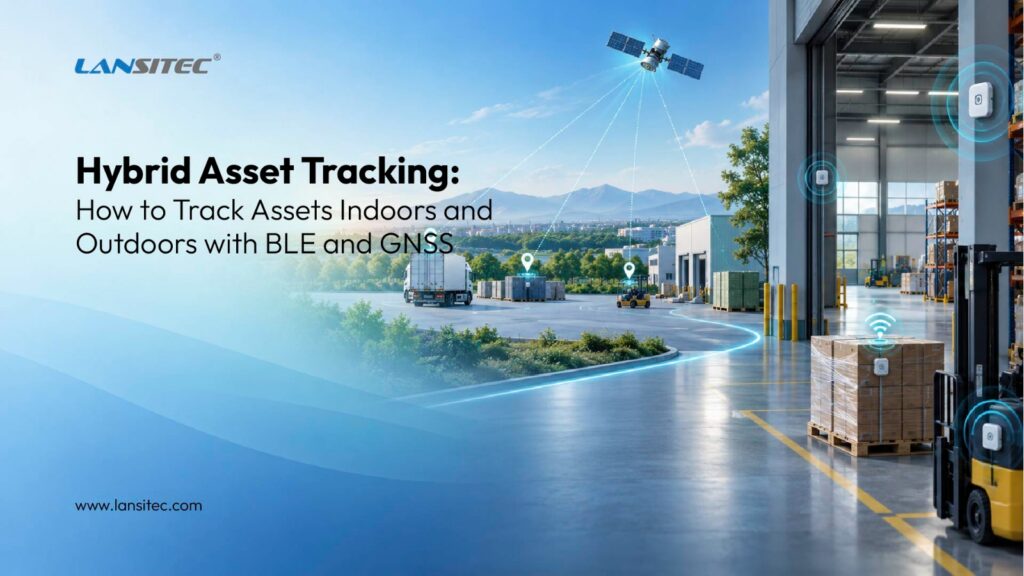
An asset can leave a warehouse, cross a yard, and arrive at another facility without changing identity. Your tracking system should work the same way.
That is harder than it sounds. GNSS works best outdoors, where the receiver can see enough of the sky. BLE is efficient and useful inside buildings, but it doesn’t provide global coordinates on its own. LoRaWAN can transport small data packets over long distances, but it is a communications network, not a positioning method. (1)
The practical answer is hybrid indoor-outdoor asset tracking: use the positioning technology that fits the current environment, then send the resulting data through the most suitable network.
Lansitec’s product range supports this architecture with BLE tags and Gateways, GNSS-enabled Tracker, LoRaWAN infrastructure, and cellular variants using NB-IoT, LTE-M, or Cat-1. Selected Produkte also support automatic switching between Bluetooth and GNSS tracking, with configurable reporting intervals.
Why Indoor and Outdoor Asset Tracking Need Different Technologies
Outdoor tracking usually means GNSS. Modern devices can combine signals from several satellite constellations, including GPS, Galileo, BeiDou, and GLONASS. GNSS is a strong choice for yards, roads, construction sites, and open industrial areas because the tracker can calculate its position without local anchors.
The limitations are just as important. Performance can degrade near roofs, metal structures, dense urban buildings, and other obstructions. GNSS also consumes more energy than a simple Bluetooth scan.
Inside a warehouse or production hall, the operational question is often different. You may not need latitude and longitude. You may need to know that a pallet is in Bay 4, a tool is in the maintenance room, or a container is still in the loading zone.
BLE is well suited to this type of proximity or zone-level visibility. A tag broadcasts its identifier, and a nearby gateway receives the signal and forwards the observation to the tracking platform. For more detailed indoor positioning, Bluetooth Angle of Arrival (AoA) uses antenna arrays to estimate a signal’s direction. As Bluetooth SIG’s expertise shows, Direction Finding can support high-accuracy indoor location services, including centimeter-level positioning in suitable deployments. (2)
The distinction is simple:
- GNSS answers: “Where is the asset geographically?”
- BLE often answers: “Which room, zone, or gateway detected it?”
- AoA can answer: “Where is it within this indoor area?”
The 4 Layers of a Hybrid Asset Tracking System
A reliable deployment separates positioning from connectivity. Confusing the two is one of the most common planning errors.
1. Asset Tracking Tag or Tracker
The device attached to the asset identifies it and collects data. Depending on the use case, it may include:
- BLE advertising or scanning
- GNSS-Positionierung
- motion detection
- temperature or other Sensoren
- a rechargeable or replaceable battery
- LoRaWAN or cellular connectivity
A low-cost BLE tag may be enough for a pallet that remains inside one facility. Equipment traveling between sites needs a tracker that can determine and transmit its own outdoor position.
2. Indoor BLE Asset Tracking
BLE Gateways are installed at known locations throughout the building. They listen for nearby tags and report the strongest or most relevant observations.
Lansitec offers indoor, compact, micro, macro, and solar-powered BLE gateway formats. The right model depends on coverage, mounting conditions, available power, and the number of nearby devices. Some gateway configurations can receive data from more than 500 Bluetooth devices in certain deployments.
If the operation needs room-level or higher accuracy, an AoA system may be appropriate. It requires more careful anchor placement, antenna orientation, and map calibration than simple proximity detection. Select it only when the workflow needs that accuracy, not because a smaller accuracy figure sounds impressive.
3. Outdoor GNSS Asset Tracking
Once an asset reaches an open area, the tracker can use GNSS. A hybrid device may activate GNSS after a movement event, when BLE infrastructure disappears, or according to a configured operating profile.
Automatic switching matters because the tracker doesn’t need to run every radio continuously. It can use Bluetooth when local infrastructure is available and GNSS when it needs an independent outdoor position.
4. LoRaWAN and Cellular Backhaul
Backhaul transports the location record to the customer’s application. It is separate from positioning.
A tracker may calculate its position with GNSS and transmit it over Cat-1. A BLE gateway may receive a tag’s broadcast and forward the observation through LoRaWAN. A cellular tracker may use NB-IoT or LTE-M where those networks are available.
LoRaWAN is an open LPWAN specification designed for battery-operated IoT devices. It supports bidirectional communication, mobility and localization services, and can be deployed through private, public, community or satellite networks. (3)
How Indoor-to-Outdoor Asset Tracking Handoff Works
Consider a roll cage moving through a distribution center.
Inside the building, Gateways near receiving, storage, and dispatch areas detect a BLE-enabled tracker. The system records the last known gateway or indoor zone. GNSS can remain inactive, reducing unnecessary battery use.
When the cage leaves the building, BLE observations may disappear. The tracker detects the change, activates GNSS, and sends an outdoor position through cellular connectivity or a LoRaWAN-based architecture, depending on the device and site design.
When the cage enters another building, GNSS may become intermittent. Once a gateway detects the tracker again, the system can return to BLE-based positioning.
The asset keeps the same identity throughout the journey. The application receives a sequence of indoor observations and outdoor coordinates, then presents them as one history.
That continuity is the real value. It closes the gap between “last seen inside” and “somewhere outside.”
Choosing the Right Technology for Indoor and Outdoor Asset Tracking
| Operating environment | Preferred positioning | Typical backhaul | Suitable architecture |
|---|---|---|---|
| Warehouse or factory | BLE proximity or AoA | LoRaWAN, Ethernet or cellular gateway | BLE tags and Gateways |
| Outdoor yard | GNSS, optionally BLE zones | LoRaWAN or cellular | GNSS or hybrid tracker |
| Long-distance transport | GNSS | Cat-1, LTE-M or NB-IoT | Cellular asset tracker |
| Remote site with gateway coverage | GNSS outdoors, BLE indoors | LoRaWAN | Tracker plus LoRaWAN Tor |
| Mixed facility and road use | Automatic BLE/GNSS switching | Cellular or LoRaWAN | Hybrid Asset Management Tracker |
| Large outdoor asset with limited service access | GNSS or BLE scanning | Cellular or LoRaWAN | Solar or long-life tracker |
This is a planning framework, not a shopping list. The right choice depends on required accuracy, network availability, update frequency, and the maintenance model.
LoRaWAN vs Cellular Backhaul for Asset Tracking
The decision usually comes down to infrastructure and mobility.
Wählen LoRaWAN when the company controls the site, campus, or yard and can install Gateways where coverage is needed. It suits low-volume sensor traffic and large numbers of low-power devices.
Choose cellular when the asset moves between sites and must bring its connectivity with it. Cat-1 generally offers more capacity than NB-IoT or LTE-M, while NB-IoT and LTE-M may be attractive where lower power consumption and operator support are more important.
A useful rule is:
Verwenden LoRaWAN when you can provide network coverage. Use cellular when the asset must carry its connectivity beyond your premises.
Some deployments use both. BLE Gateways can provide dense indoor visibility, while cellular Tracker provide independent outdoor coverage for mobile or high-value assets.
How Asset Tracking Reporting Intervals Affect Battery Life
“Real-time tracking” does not necessarily mean reporting every second. Excessive reporting can drain the battery and generate data that nobody uses.
A stationary pallet may need a heartbeat every 30 minutes and an immediate update when it moves. A vehicle-mounted asset may need a position every few minutes during transit. A safety-critical workflow may require a much shorter interval.
Lansitec offers configurable Bluetooth and GNSS reporting intervals in five-second multiples for several hybrid Produkte. The important question is not how frequently the device can report. It is how frequently the operation needs a new decision.
Consider separate profiles:
- Storage mode: infrequent heartbeat with movement-triggered updates
- Yard mode: regular BLE or GNSS updates
- Transit mode: more frequent GNSS reporting
- Recovery mode: temporarily aggressive reporting after theft or geofence breach
Which Asset Tracking Architecture Fits Your Application?
Der Asset-Management-Tracker is the clearest fit for mixed indoor and outdoor environments. It features Bluetooth 5.0 scanning, GNSS, automatic Bluetooth/GNSS tracking switching, configurable reporting, and a 2 × 4,000 mAh battery configuration.
Der Solar-Tracker is worth considering for large outdoor assets that are difficult to recharge regularly. Solar charging can reduce service visits, but the installation still needs suitable light exposure, mounting, and seasonal planning.
A BLE gateway architecture may be more economical when many low-cost tags remain within a defined facility. Lansitec’s indoor, Micro, Compact, Macro, and Solar BLE Gateways can be selected based on coverage and power requirements.
For assets traveling independently between sites, a Cat-1, LTE-M, or NB-IoT tracker can provide direct wide-area connectivity. The final choice should follow operator coverage, expected battery life, data volume, and regional availability.
Häufig gestellte Fragen
About Hybrid Asset Tracking
How often should a tracker report?
Set the interval based on operational needs. Use longer heartbeats for stationary assets, movement-triggered updates for storage, and more frequent GNSS reports during transit or recovery.
Can one tracker work indoors and outdoors?
Yes, if it combines an indoor method such as BLE with an outdoor method such as GNSS. The tracker or application must also define how the system selects and reconciles the two sources.
Is GNSS reliable inside buildings?
Not consistently. Roofs, walls, metal structures, and limited sky visibility can weaken or block satellite signals. Indoor BLE infrastructure is usually more predictable for room or zone visibility.
Does hybrid tracking require two separate platforms?
Not necessarily. The customer’s application should combine BLE observations and GNSS coordinates into one asset record. Lansitec supplies the tracking hardware and connectivity options; dashboards, maps, and workflows depend on the customer’s selected platform and integration design.
Best Practices for Hybrid Indoor-Outdoor Asset Tracking
Hybrid indoor-outdoor asset tracking is not one radio replacing another. It is a coordinated architecture.
BLE provides practical indoor visibility. AoA adds directional accuracy where the workflow justifies it. GNSS provides independent outdoor positioning. LoRaWAN and cellular networks transport the records. Configurable reporting intervals keep the system useful without exhausting the battery.
For companies managing assets across warehouses, yards, roads, and multiple sites, the goal is not to force one technology to do everything. The goal is to give each technology the job it handles best, then present the result as one continuous asset history.
 English
  ไทย
ไทย  한국어
한국어  Français
  Deutsch
  Español
  日本語
日本語  العربية
  Italiano
  Português