
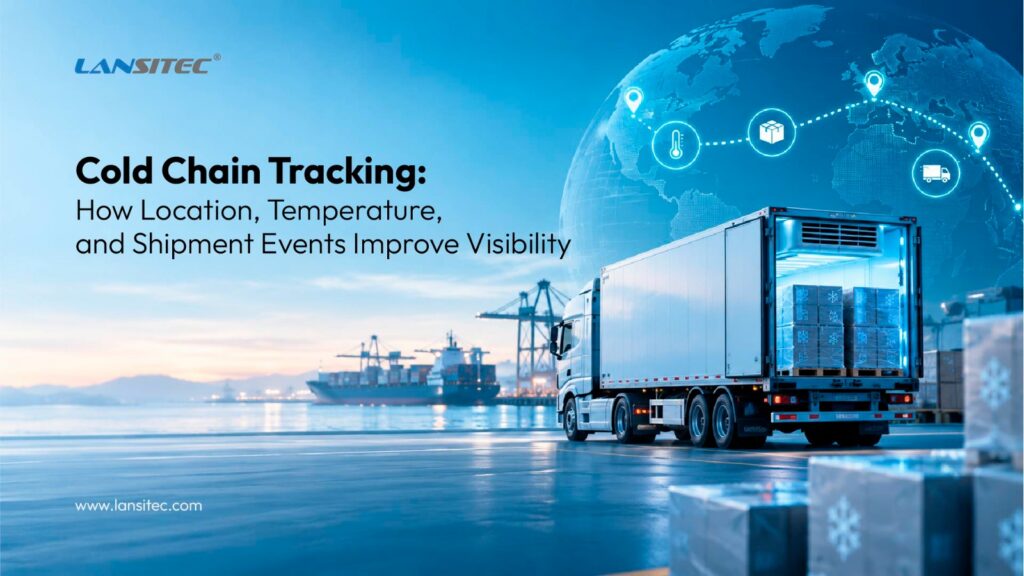
Temperature sits at the center of cold chain monitoring, but a temperature reading rarely tells the whole story.
Suppose a shipment exceeds its permitted range at 14:35. Where was it? Was the vehicle moving? Had someone opened the container? How long had the shipment been waiting? Did it suffer a shock? Who had custody at the time?
Without those answers, the temperature alert identifies a problem but does little to explain it.
A more useful cold chain tracking system combines temperature with location, door status, shock, movement, dwell time, and custody history. Together, these signals turn an isolated alert into an incident timeline that teams can investigate and act on.
Why Temperature Monitoring Alone Is Not Enough for Cold Chain Tracking
A temperature curve can show when conditions moved outside a specified range. It cannot tell you why.
The same temperature increase might result from:
- A door left open during unloading
- A refrigerated container waiting without power
- A delayed handover on an exposed loading dock
- Incorrect pre-cooling before departure
- Refrigeration equipment failure
Each cause requires a different response. If a shipment has already arrived, the receiver may also need to decide whether to accept it, quarantine it, or request further assessment.
WHO’s 2020 guidance takes a broader view of transport monitoring. It recommends recording environmental conditions, using technologies such as GPS to improve traceability, and documenting and investigating damage or other events that occur in transit. (1) The CDC’s 2026 vaccine-storage resources similarly ask teams investigating an excursion to document what happened, when it happened, and how long the product may have remained outside the expected range. (2)
Temperature remains essential. Context makes it actionable.
6 Key Data Signals for Complete Cold Chain Monitoring
Each signal answers a different question about the shipment.
| Signal | Question it answers | Potential response |
|---|---|---|
| Temperatura | Did conditions leave the specified range? | Inspect, quarantine, accept, or reject |
| Ubicación | Where did the issue occur? | Investigate a route, depot, dock, or warehouse |
| Door status | Was the container opened? | Check handling procedures or unauthorized access |
| Shock and vibration | Was the cargo mishandled? | Inspect productos and packaging |
| Movement and dwell time | Was the shipment travelling or waiting? | Escalate a delay or change the process |
| Custody history | Who controlled the shipment? | Send the incident to the responsible party |
Temperature Monitoring Detects Cold Chain Excursions
Temperature data establishes whether the shipment remained within its required range. A useful record should show more than the highest or lowest reading. It should capture when the excursion began, how long it lasted, how far conditions moved outside the range, and whether the shipment recovered.
Duration matters. A short increase during unloading may carry a different level of risk from several hours of exposure, depending on the product and its stability data.
The monitoring system should preserve readings from before, during, and after the event. A single threshold alert is rarely enough for a proper assessment.
Location Tracking Shows Where an Excursion Occurred
Without location data, an excursion somewhere between the shipper and receiver can trigger calls to several carriers, warehouses, and handling partners.
GNSS, indoor Bluetooth positioning, and facility-zone data can identify where the change began. Was the shipment on the road, sitting at a port, waiting in a warehouse staging area, or already at the receiver?
Location history also reveals patterns. If several shipments develop problems at the same transfer point, the real issue may be slow unloading, insufficient pre-cooling, or a gap between cold storage and the vehicle.
Door Sensors Help Explain Temperature Excursions
A door-open event creates a plausible explanation for a rapid temperature rise.
The event becomes more useful when the system also knows where the container was and how long the door remained open. A planned opening at the destination is different from an opening at an unapproved location.
Door sensing can therefore support both cold chain operations and shipment security. It does not prove the cause of an excursion, but it gives investigators a specific event to compare with the temperature timeline.
Shock and Vibration Detect Cold Chain Handling Problems
Not every cold chain failure is thermal. Glass vials, laboratory samples, fresh produce, electronics, and other sensitive goods can be damaged by drops, impacts, or sustained vibration even when temperature remains within range.
A shock event tied to a location and timestamp may point to mishandling during sorting or transfer. Movement duration and vibration intensity can provide additional evidence about how the shipment traveled.
This is especially useful when productos arrive damaged, but the temperature record appears normal.
Dwell Time Tracking Identifies Hidden Cold Chain Delays
Cold chain risk often accumulates while goods are waiting. A pallet may remain beside a loading bay. A container may sit unplugged at a terminal. A delivery vehicle may arrive before the receiving team is ready.
Dwell time can be calculated from movement and location records. Instead of waiting for a temperature limit to be crossed, the system can identify that a shipment has remained in a risky zone longer than expected.
Por ejemplo:
Shipment stationary in an outdoor loading area for more than 20 minutes while temperature continues to rise.
That warning gives the team a chance to intervene before the situation becomes a confirmed excursion.
Chain of Custody Tracking Shows Who Controlled the Shipment
Cold chain shipments may pass between a manufacturer, freight forwarder, carrier, warehouse, customs authority, distributor, and receiver.
A useful record should connect sensor events with those handovers. At minimum, each custody event should identify the shipment, location, time, sending party, receiving party, and acceptance status.
The FDA’s Sanitary Transportation Rule addresses responsibilities across pre-cooling, loading, transport, unloading, and receipt. It also requires information exchange between shippers, carriers, loaders, and receivers in applicable food-transport operations. (3)
GS1’s EPCIS framework supports the same wider view. It provides a standard way to capture the what, when, where, why, and how of an asset’s journey, including its location, movement, status, and chain of custody. (4)
Cold Chain Temperature Excursion: A Real-World Tracking Example
Consider this illustrative sequence:
| Time | Recorded event |
|---|---|
| 10:04 | Vehicle enters the receiver’s geofence |
| 10:09 | Vehicle stops in the outdoor loading area |
| 10:18 | Container door opens |
| 10:25 | Temperature begins rising |
| 10:41 | Door closes |
| 10:46 | Shipment moves into the facility |
| 10:58 | Receiver accepts custody |
| 11:12 | Temperature returns to its expected range |
A temperature-only system would show an excursion between approximately 10:25 and 11:12.
The contextual record shows considerably more. The vehicle arrived before unloading began. The door remained open for 23 minutes. The temperature started rising before the receiver formally accepted custody.
That evidence does not automatically determine whether the productos remain usable. Product-specific stability data and qualified review may still be required. It does, however, speed up the operational investigation.
Choosing the Right Cold Chain Tracking Device
Cold chain tracking can operate at package, pallet, case, or container level. The right hardware depends on the required sensor accuracy, connectivity, shipment value, and whether the tracking device will be reused.
| Producto | Most useful cold chain role | Relevant context |
|---|---|---|
| Etiqueta de seguimiento LoRaWAN | Packages, pallets, and lower-cost shipments | GNSS, Bluetooth positioning, motion detection |
| Rastreador de contenedores | Containers, trailers, and long-haul shipments | Location, door events, movement, shock, tamper detection, BLE-tag inventory, offline cache |
| Seguimiento de la gestión de activos | Reusable cases, pallets, and high-value assets | Location, door status, shock, movement, tamper detection, BLE-tag inventory |
| Separate qualified sensor or logger | Regulated or narrow-tolerance cargo | Calibrated product or ambient temperature data |
El Etiqueta de seguimiento combines GNSS, Bluetooth 5.0, LoRaWAN, and a 3-axis accelerometer in a 3 mm-thick disposable format. It can provide shipment-level location and movement history without placing a reusable tracker on every package.
Lansitec Container Tracker variants add functions such as door open/close sensing, movement-duration reporting, vibration-shock detection, tamper alerts, and nearby Bluetooth-tag scanning. They can also store up to 40 positions during a network outage.
BLE-tag scanning creates another useful layer. The tracker identifies the container or transit case, while the tags help confirm which items were inside. This connects the transport unit with its contents.
Different versions use LoRaWAN, Cat-1, or NB-IoT/LTE-M connectivity. The choice depends on network availability, infrastructure, reporting needs, and operating cost. Lansitec supplies the hardware and communication layer, while customers can send the data to their chosen cloud, on-premises application, or traceability platform.
Cold Chain Monitoring vs Compliance-Grade Temperature Measurement
Lansitec’s devices support optional temperature reporting for several tracker models. However, this is the temperature inside the device enclosure and has a specified accuracy of ±5°C.
That may provide useful environmental context, but it should not automatically be treated as a compliance-grade product-temperature measurement.
Regulated pharmaceuticals, vaccines, laboratory materials, and tightly controlled food shipments may require a qualified sensor with specific accuracy, placement, calibration, and validation. WHO’s 2020 guidance states that monitoring equipment should be suitable for its intended use and calibrated. It also requires maintaining, monitoring, and recording appropriate transport conditions. (1)
Sensor placement matters too. The temperature inside an external tracker enclosure is not necessarily the same as:
- Air temperature inside the cargo area
- Temperature inside an insulated package
- Surface temperature of the product
- Temperature at the warmest or coldest point in the load
In these deployments, a qualified temperature logger can provide the critical measurement while the Lansitec tracker supplies location, door, shock, movement, and connectivity context.
How to Create Actionable Cold Chain Alerts
Más sensores can easily create more noise. The system should therefore combine signals into operational rules instead of alerting on every individual event.
Useful alerts might include:
- Temperature outside the permitted range for a defined duration
- Door opened outside an approved location or delivery window
- Temperature rising while the shipment remains stationary
- Shock followed by a door, movement, or temperature anomaly
The thresholds should come from the product specification, packaging qualification, route risk, and operating procedures. A generic cold chain template cannot determine whether a particular shipment remains safe.
It is also worth deciding who receives each alert. A carrier may need to respond to an extended roadside stop, while a quality manager may need to assess a completed excursion. Sending every alert to everyone usually produces alert fatigue.
Preguntas frecuentes
About Cold Chain Tracking
Is Temperature Monitoring Enough for Cold Chain Compliance?
Not always. Requirements depend on the product, jurisdiction, transport method, and quality system. Compliance may also require calibrated equipment, documented procedures, traceable records, defined responsibilities, and qualified review.
Can Door Sensores Identify the Cause of a Temperature Excursion?
No. It can establish that a door event occurred near the start of an excursion. Investigators should also review duration, location, movement, temperature direction, and recovery.
What Happens When a Cold Chain Tracker Loses Network Coverage?
Rastreadores with offline caching can store a limited number of positions and report them after connectivity returns. The deployment should account for cache capacity, reporting frequency, and the expected duration of coverage gaps.
Can a Cold Chain Tracker Replace a Calibrated Temperature Logger?
Not if its accuracy, placement, calibration, or validation does not meet the application’s requirements. The tracker and logger can instead perform complementary roles.
How Complete Cold Chain Tracking Improves Shipment Investigations
Temperature monitoring tells you that a shipment may have a problem.
Location shows where it happened. Door and movement data suggest why. Shock reveals possible mishandling. Dwell time exposes delays. Custody history identifies who controlled the shipment.
That complete timeline helps teams respond earlier and investigate faster. It also gives quality teams better evidence when they must decide whether to accept, quarantine, or reject a shipment.
Monitor the temperature, certainly. Just don’t stop there.
Referencias y lecturas adicionales:
- World Health Organization, TRS 1025, Annex 7: Good Storage and Distribution Practices for Medical Products, 2020
- CDC, Vaccine Storage and Handling Toolkit: Key Resources, July 2026
- U.S. FDA, Frequently Asked Questions on the FSMA Sanitary Transportation Rule
- GS1, 2D Barcodes at Retail Point-of-Sale Implementation Guideline


 English
  ไทย
ไทย  한국어
한국어  Français
  Deutsch
  Español
  日本語
日本語  العربية
  Italiano
  Português