
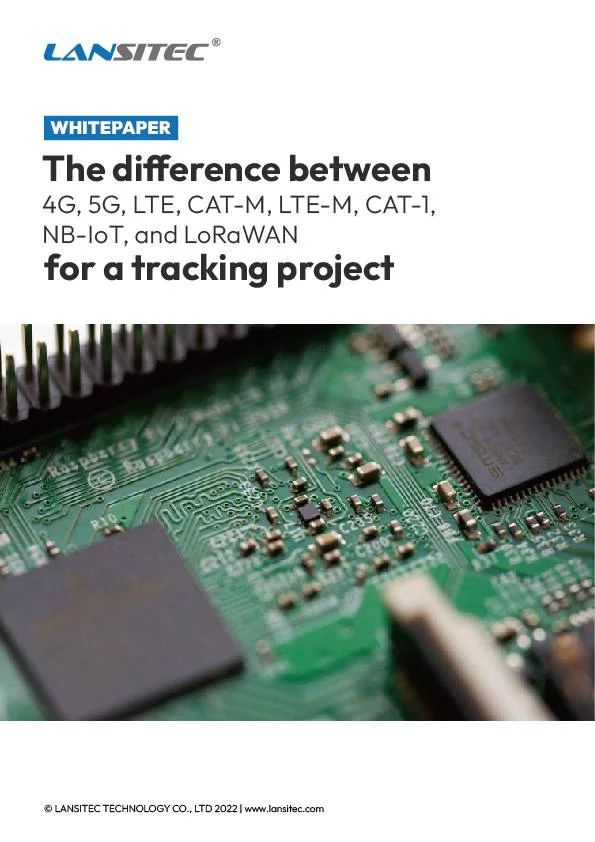
CAT-M vs LTE-M (Long-Term Evolution for Machines) are two different names for the same thing: a device category in the LTE family of cellular technologies designed for aplicações de IoT. CAT-M and LTE-M devices have some advantages over traditional LTE devices, such as lower power consumption, longer battery life, better coverage, and lower cost. However, they also have limitations, such as lower data rates, narrower bandwidth, and reduced functionality. The main differences are:
CAT-M vs LTE-M
Largura de banda
CAT-M and LTE-M devices use a bandwidth of 1.4 MHz, which is much smaller than the typical 20 MHz bandwidth used by other LTE devices. This means that they can fit more devices in the same spectrum and have less data capacity and speed.
DataRates
CAT-M and LTE-M devices have peak data rates of up to 1 Mbps in both downlink and uplink, which is sufficient for most aplicações de IoT but not for high-bandwidth services like video streaming or gaming. Other LTE devices can reach up to 10 Mbps in downlink and 5 Mbps in uplink (CAT-1) or even higher (CAT-4 and above).
Consumo de energia
CAT-M and LTE-M devices have lower power consumption than other LTE devices, meaning they can operate on batteries for longer periods. They also support power-saving features like Power Saving Mode (PSM) and Extended Discontinuous Reception (eDRX), which allow them to sleep or reduce their activity when not in use.
Coverage
CAT-M and LTE-M devices have better coverage than other LTE devices, especially in indoor and rural areas. They can use repetition and link adaptation to improve their signal quality and reliability. They also support Coverage Enhancement Mode (CEM), which allows them to transmit at higher power levels and receive at lower signal levels.
Comlexity
CAT-M and LTE-M devices have lower complexity than other LTE devices, meaning they have simpler hardware and software requirements. They also have fewer features and functionalities, such as voice support, carrier aggregation, or multiple antennas.

 English
 ไทย
 한국어
 Français
 Deutsch
 日本語
 العربية
 Italiano
 Español de Chile
 Português (AO90)