
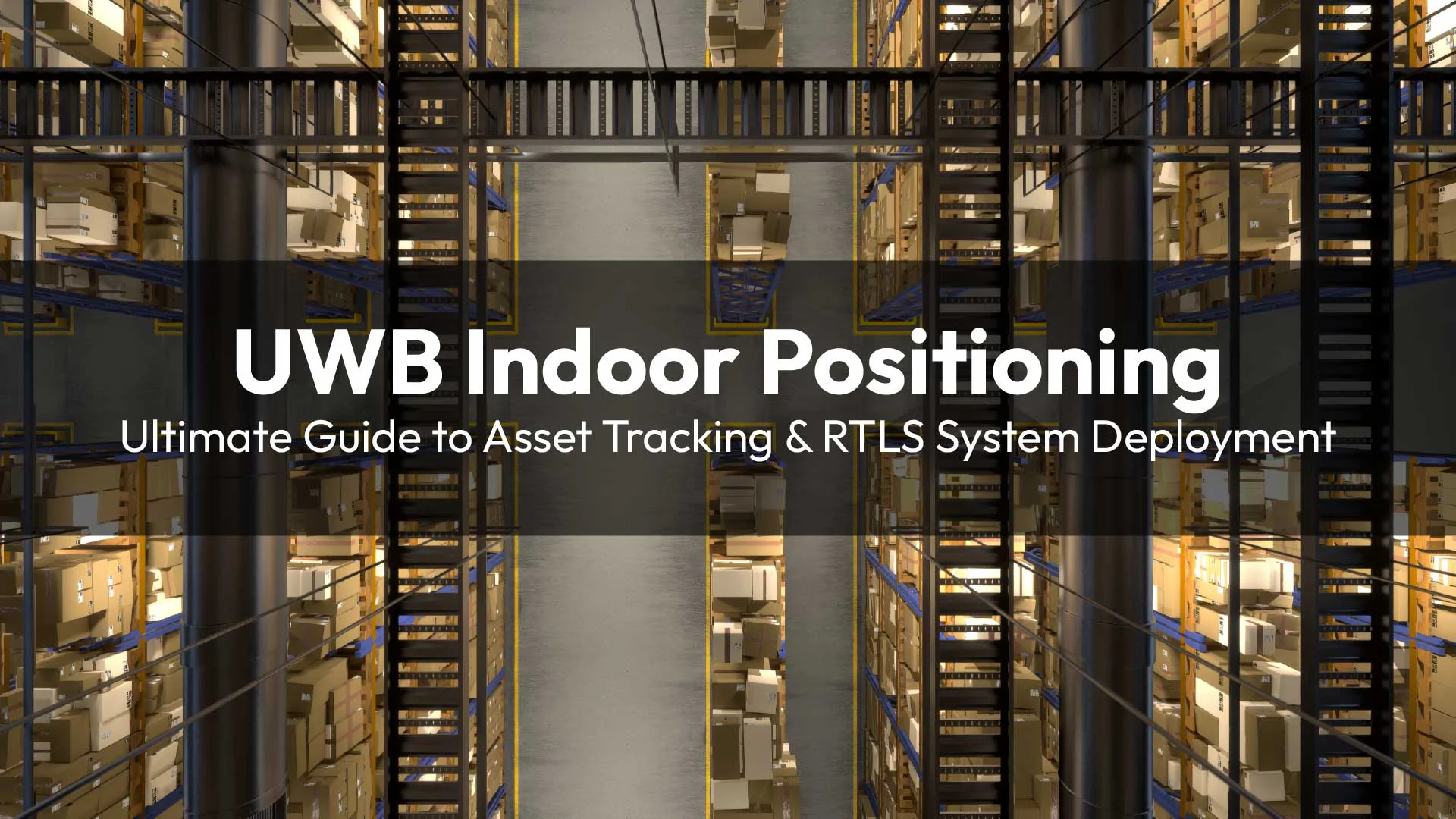
Ultra-wideband (UWB) gives you indoor location accuracy down to centimetres. In this guide, we unpack how it works, what to buy, and how we deploy it with Lansitec’s UWB + LoRaWAN stack.
What is UWB Indoor Positioning? Technology, ToF Ranging, and Centimeter Location Accuracy
UWB measures precise time-of-flight (ToF) between mobile tags and fixed anchors to compute distance, then resolves a 2D/3D position from several such ranges. Unlike RSSI-based Bluetooth, UWB’s time resolution delivers ~10 cm accuracy in typical indoor spaces—enough to find the right tool bay, pallet slot, or even the nearest nurse station. Lansitec’s UWB line is built explicitly around ToF ranging and designed to ride LoRaWAN for the low-power backhaul.
UWB-over-LoRaWAN Explained: Real-Time Asset Tracking, Anchors, Trackers & Gateways
Here’s the flow we’ve seen work over and over:
- Anchors (battery-powered, IP66) sit on walls or overhead trusses. They time-sync, listen for rastreadores, compute distances, then forward heartbeat and timing data out via LoRaWAN 1.0.2B. Anchors support up to 512 rastreadores and quote ±10 cm accuracy with UWB ToF.
- Rastreadores (badge, asset, or container form factors) measure to nearby anchors; positions are calculated server-side and surfaced in your app/RTLS. UWB receive range is up to ~23 m in typical conditions.
- Backhaul uses LoRaWAN to push summaries/heartbeats through a LAN or cellular LoRaWAN gateway to your platform. (Lansitec provides indoor portões with PoE and a built-in network server for simple pilots.)
- Lifecycle is straightforward: FOTA over Bluetooth for all UWB devices, adjustable report intervals, and TDMA to keep airtime orderly in busy cells.
UWB Core Components for RTLS: Anchors, Trackers & Industrial LoRaWAN Gateways
| Element | Descrição |
| UWB Anchors | IP66, -45 °C to +85 °C, dual 19 000 mAh Li-SOCl₂ (38 000 mAh total), LoRaWAN 1.0.2B, supports up to 512 rastreadores; UWB region bands listed per market. |
| UWB Trackers | Choose Badge (600 mAh Li-ion, rechargeable), Asset (IP66, 2×4000 mAh Li-SOCl₂), or Container (IP68, 2×4000 mAh Li-SOCl₂). All specify ~10 cm indoor precision and UWB receive range up to ~23 m. |
| LoRaWAN Gateway (indoor) | SX1302-based, PoE, OpenWRT, built-in network server; ideal as a backhaul head for UWB pilots and production floors. |
UWB Network Design: Anchor Spacing, Tracker Density, Backhaul Planning for Warehouses & Hospitals
Rule of thumb—we start from the physics, then bend to the building.
UWB Anchor Placement & Spacing: Coverage Maps for High-Accuracy RTLS
With a documented UWB receive range up to ~23 m, we plan 15–20 m spacing in clear aisles and tighten near steel racks, elevators, or thick masonry. Triangulation wants 3–4 anchors in view at any point; high-bay warehouses often benefit from a perimeter ring + one or two interior lines.
Tracker Density & Throughput: Scaling UWB RTLS Systems for Large Facility Deployments
One anchor supports dozens to hundreds of rastreadores; Lansitec publishes explicit guidance up to 512 trackers/anchor with TDMA. For fast-moving pallets or AGVs, we shorten the position/heartbeat interval; for parked assets, we let motion-based low-power modes take over.
LoRaWAN Backhaul for UWB: Gateways, Link Budgets, and Edge-to-Cloud Network Scaling
A single indoor gateway can service >500 LoRa nodes with >1.5–2 km urban LoRa link budget, easily covering a typical facility. If you already run LoRaWAN for sensores, UWB rides the same network server.
When we mapped a 6-aisle, 5-meter-bay warehouse, we ended up with 11 anchors for ~4000 m². The punchline? Operators stopped hunting for torque wrenches.
UWB Accuracy vs Battery Life: Data, Performance Metrics & Power Optimization
This is where the Lansitec docs are refreshingly specific. For the Âncora UWB (38 000 mAh) and Badge Tracker (600 mAh), Lansitec provides indicative lifetimes based on how many rastreadores are active in the cell (TDMA + reporting cadence):
- 64 rastreadores → Anchor ~18 years, Badge ~37 days
- 192 rastreadores → Anchor ~10 years, Badge ~32 days
- 512 rastreadores → Anchor ~4.8 years, Badge ~25 days
Container/asset rastreadores with 8 000 mAh show ~11–16 months under similar assumptions. Tuning intervals and motion thresholds move these numbers up or down.
UWB Security & Maintenance: AES-128 Encryption, FOTA Updates & Global Compliance Certifications
Everything ships with AES-128 for LoRaWAN frames. Fleet updates are painless via FOTA over Bluetooth. Certifications include CE/FCC across anchor and rastreadores. That combination—encryption at the network edge + predictable OTA—keeps IT friendly and ops happy.
UWB vs BLE AoA for Indoor Asset Tracking: Comparison, Use Cases & Power Trade-offs
Think in accuracy tiers and infrastructure appetite. We’ve seen this rule of thumb hold up across factories, hospitals, and warehouses:
- UWB (ToF): ≈10 cm. Use when precision is mission-critical: tool cribs, kitting lanes, OR equipment, red-zone worker safety. You’ll plan 3–4 anchors in view (about 15–20 m spacing) and accept higher tag power draw (badges typically 3–5 weeks between charges in busy zones).
- BLE AoA: ~1–3 m. Good for wayfinding and non-critical logistics. Accuracy is solid if arrays are well placed, but you’ll budget for cabled antenna arrays and LAN drops. Tag batteries last longer.
- BLE Proximity (RSSI): ~2–3 m zone/room. Lowest TCO. Use for presence, headcount, coarse asset zoning. Easiest to blanket large areas and tag batteries run months–years.
Our favorite hybrid: lay a BLE blanket for broad coverage and commissioning, then drop UWB pockets only where centimeters save minutes (tool rooms, danger zones). Same LoRaWAN backhaul, happier ops.
UWB RTLS Deployment Checklist: Survey, Anchor Planning, Gateway Setup & Scalable Rollouts
- Survey & RF sanity check: walk the floor, mark LOS breaks, note RF-unfriendly metal.
- Anchor plan: place for 3–4 in-view coverage; confirm power (anchors are battery, so mounting is fast).
- Gateway & NS: PoE indoor gateway, register devices, confirm LoRaWAN region (US915/EU868/AS923/etc.).
- Pilot lane: 2–3 aisles, 50–100 rastreadores; tune reporting intervals vs. battery.
- Scale-out: replicate pattern, add alerting (geo-fences, dwell), and FOTA the fleet when firmware bumps.
UWB RTLS FAQs: Precision, Capacity, Supported Regions & LoRaWAN Integration
How accurate is Lansitec’s UWB indoors?
We design for ~10 cm under typical conditions, using UWB ToF with synchronized anchors.
How many trackers can a single anchor handle?
Published guidance is up to 512 rastreadores per anchor with TDMA.
What UWB range should I assume per anchor?
Plan for ~23 m receive range in clear spaces, then tighten spacing around metal or concrete.
Which LoRaWAN regions are supported?
Rastreadores list US915, EU868, AS923, LA915, RU864, KR920, IN865, KZ865, CN470, and more—match devices to your locale.
How do I update firmware across the fleet?
Use FOTA over Bluetooth; it’s standard across the UWB anchor e rastreadores.
Do I need mains power for anchors?
No. Anchors are battery-powered (38000 mAh); install is basically mount-and-sync.
What about gateway power?
The indoor LoRaWAN gateway supports PoE, which simplifies placement near your network core.

 English
 ไทย
 한국어
 Français
 Deutsch
 日本語
 العربية
 Italiano
 Español de Chile
 Português (AO90)