
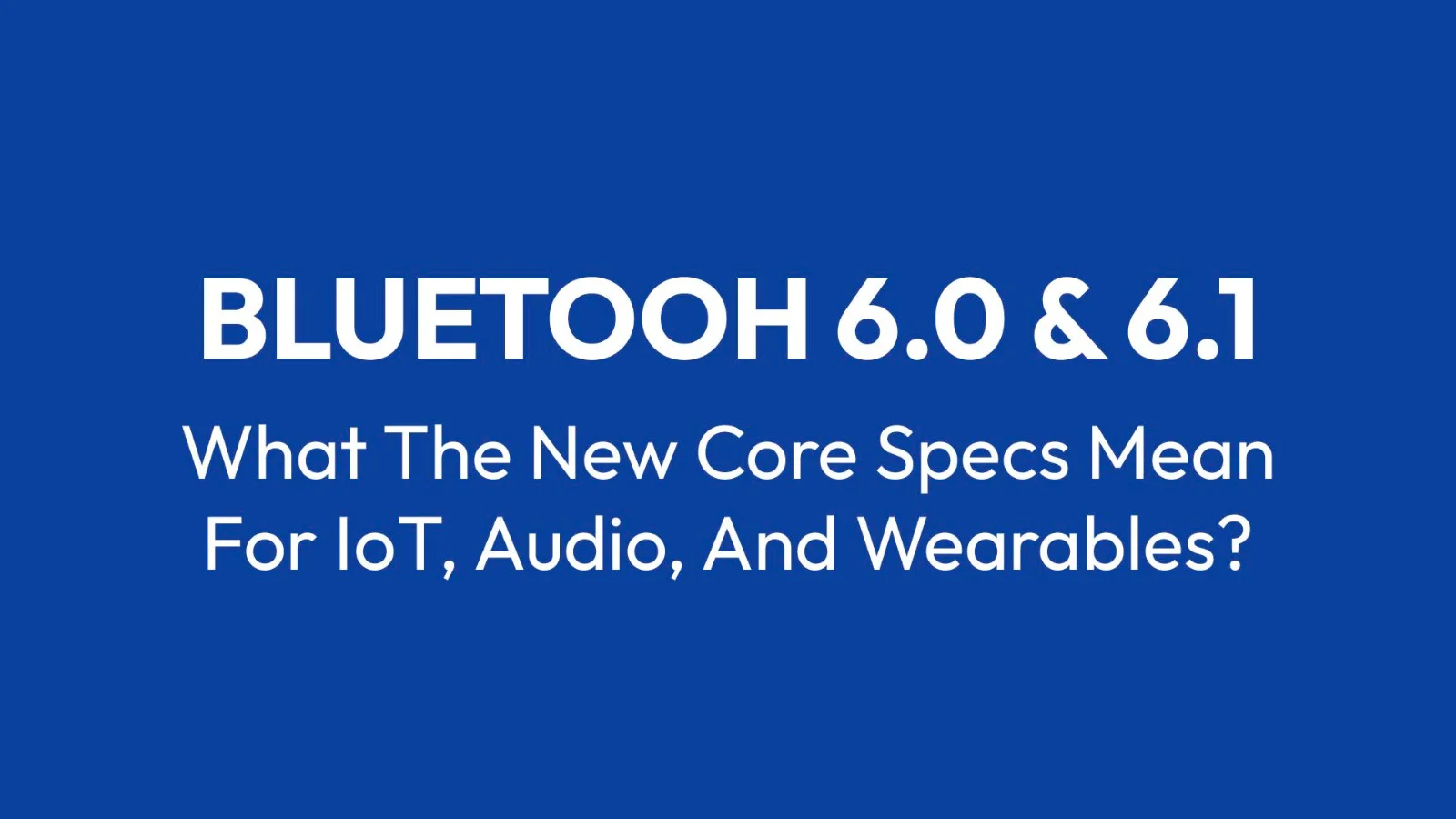
Bluetooth 6.0 and 6.1 are the latest generations of the Bluetooth Core Specification from the Bluetooth Special Interest Group (SIG). Core 6.0 was adopted in September 2024, and Core 6.1 followed in May 2025 with a new privacy and power feature plus errata. (1)
They build on Bluetooth 5.x rather than replacing it. Think of them as “deployment upgrades” that make Bluetooth smarter at ranging, scanning, privacy, and energy use instead of chasing data rates.
What are the key features of Bluetooth 6.0 technology?
The official Bluetooth Core 6.0 feature overview from the SIG lists six headline additions: Channel Sounding, Decision-Based Advertising Filtering (DBAF), Monitoring Advertisers, ISOAL enhancement, LL Extended Feature Set, and Frame Space Update. (1)
In practical terms, Bluetooth 6.0 brings:
Channel Sounding for centimeter-level ranging
Channel Sounding is the flagship feature. It lets two Bluetooth devices measure distance using phase-based ranging and round-trip timing, targeting “centimeter-level” accuracy over distances up to roughly 150 meters.
Typical use cases include digital keys and secure access (cars, doors, lockers), “find my device” and item trackers without needing UWB silicon, and indoor positioning for logistics, healthcare, and retail.
Decision-Based Advertising Filtering (DBAF)
DBAF lets a scanner use information from the primary advertising channel to decide whether it should bother listening for related packets on secondary channels.
That means:
- Less time wasted decoding irrelevant advertisements
- Less hopping to secondary channels
- More predictable behavior in beacon-heavy environments
Comarch’s overview explains DBAF as a way to “reduce power consumption and increase performance” by filtering at the controller level.
Monitoring Advertisers
Before 6.0, an observer could filter duplicate advertisements, but then had no clean way to know when a device left or re-entered range. The usual workaround was periodic high-duty scans, which is wasteful.
Monitoring Advertisers adds Host Controller Interface (HCI) events that tell the host when a monitored advertiser appears or disappears.
This results in fewer “blind” scans for devices that are already gone, faster reconnection when devices return, and better user experience for earbuds, wearables, tags, etc.
ISOAL enhancement, LL Extended Feature Set, Frame Space Update
These three are more low-level but important. What do they mean?
ISOAL enhancement reduces latency and improves reliability for isochronous traffic, especially LE Audio and real-time applications.
LL Extended Feature Set lets devices advertise and negotiate a larger set of Link Layer capabilities for richer, future-proof connections.
Frame Space Update makes the inter-frame spacing (T_IFS) negotiable instead of fixed at 150 µs, so controllers can tune timing to hit latency or robustness targets.
IoT Business News has a good “systems view” of how these changes translate into better spectrum usage, reliability, and scalability.
How does Bluetooth 6.0 improve battery life?
In our IoT projects, battery life is usually the first thing customers ask about. Bluetooth 6.0 helps in three main ways:
Smarter scanning and less radio airtime
DBAF and Monitoring Advertisers both cut unnecessary radio and CPU work:
- DBAF filters irrelevant advertising chains early at the controller
- Monitoring Advertisers lets the controller send simple “in range / out of range” events instead of forcing the host to rescan repeatedly
The Bluetooth SIG explicitly notes that DBAF “improves scanning efficiency by reducing the time spent scanning on secondary channels for packets which might not contain PDUs that are relevant.” (1)
Less scanning time means less energy per discovered device. In dense environments like malls or smart factories, that difference adds up.
Fewer retries and more efficient coexistence
Bluetooth 6.0 refines scheduling and coexistence in crowded 2.4 GHz environments with Wi-Fi 6/7, Thread, Zigbee, and proprietary links. That reduces collisions, retransmissions, and overhead for maintaining stable links.
In practice, every avoided retry is energy you keep in the battery instead of spraying into the air as failed packets.
More efficient audio and isochronous traffic
The ISOAL enhancement in 6.0 lowers latency and improves reliability for LE Audio streams.
Why does that matter for power?
- Tighter timing and fewer glitches reduce the need for buffering and retransmissions
- Devices can spend more time in low-power states between well-scheduled bursts of traffic
We have already seen silicon vendors position Bluetooth 6.0 as a way to get “better sound at the same or lower power” in earbuds and headsets, especially when combined with LE Audio and Auracast.
What does Bluetooth 6.1 bring on top of 6.0?
Bluetooth 6.1 is a smaller but important release. The Bluetooth SIG moved to a twice-per-year core update schedule, so 6.1 is intentionally incremental.
This release introduces Bluetooth® Randomized RPA (resolvable private address) Updates, a feature designed to enhance privacy and power efficiency in Bluetooth devices. (2)
Bluetooth 6.1’s core idea: privacy and power through smarter address changes.
Bluetooth devices often rotate their Bluetooth address to protect user privacy. In earlier versions, these RPA changes happened at fixed intervals, often around 15 minutes. That predictability can be abused to correlate activity and track a device over time.
Bluetooth 6.1 changes two things:
- Randomized timing for RPA changes
- Default rotation is randomized within a window (for example between 8 and 15 minutes).
- Implementations can choose custom intervals, typically from about 1 second to 1 hour.
This randomness makes correlation attacks much harder, because an attacker can no longer rely on a stable rotation schedule.
- RPA updates handled in the controller, not the host CPU
- The Bluetooth Controller takes over address update work
- The host processor can stay asleep more often, and it does less bookkeeping
Offloading RPA updates to the controller reduces CPU load, which directly cuts energy use for wearables, earbuds, sensors, and medical devices.
From an IoT or device-maker perspective, Bluetooth 6.1 delivers stronger privacy by default, useful for healthcare wearables and location-sensitive tags. It also brings small but meaningful battery gains at scale, especially for fleets of low-power nodes.
Perguntas frequentes
Sobre o Bluetooth 6.0 e 6.1
What is Bluetooth 6.0 in simple terms?
Bluetooth 6.0 é a versão principal mais recente da especificação Bluetooth Core, introduzida em 2024. Ela se concentra em três grandes áreas: medição de distância muito mais precisa, varredura mais inteligente e eficiente e menor latência para streaming e outros dados sensíveis ao tempo. A especificação Core é definida e mantida pelo Bluetooth SIG e a visão geral oficial dos recursos agrupa as novas funções em Sondagem de Canal, Filtragem de Anúncios Baseada em Decisão, Monitoramento de Anunciantes, aprimoramentos do ISOAL, um conjunto estendido de recursos da camada de enlace e um intervalo de quadros flexível. (1)
What are the key new features of Bluetooth 6.0?
O principal recurso é o Bluetooth Channel Sounding, que permite que dois dispositivos meçam a distância com precisão em nível de centímetro para aplicações como chaves digitais, rastreamento de ativos ou redes do tipo “encontre-me”. Bluetooth 6.0 Também adiciona Filtragem de Publicidade Baseada em Decisão e Monitoramento de Anunciantes, permitindo que os dispositivos sejam mais seletivos em relação aos pacotes de publicidade que consideram relevantes, reduzindo a quantidade de varreduras necessárias e, ainda assim, reagindo rapidamente quando um dispositivo entra ou sai do alcance. Além disso, uma camada ISOAL (Isochronous Adaptation Layer) aprimorada e um espaçamento entre quadros configurável melhoram a latência e a confiabilidade para tráfego isócrono, como áudio LE e outros fluxos de dados contínuos. (1)
How does Bluetooth 6.0 help battery life in real devices?
As melhorias na duração da bateria resultam principalmente da redução do trabalho desnecessário realizado via rádio. Com a Filtragem de Anúncios Baseada em Decisão, um scanner pode analisar o primeiro pacote em um canal de publicidade primário e decidir se vale a pena continuar ouvindo os pacotes subsequentes, em vez de sempre buscar cada pacote secundário. O Monitoramento de Anunciantes também ajuda o host a saber quando um dispositivo realmente saiu do alcance, evitando longas varreduras com alto ciclo de trabalho para algo que já não está mais lá. Análises voltadas para o consumidor apontam que essa filtragem mais inteligente significa que os rádios não estão “sempre escaneando” e que essa maior eficiência deve prolongar a duração da bateria tanto de telefones quanto de acessórios compatíveis. Bluetooth 6.0. (1)
What does Bluetooth 6.1 add on top of Bluetooth 6.0?
Bluetooth 6.1 é uma atualização pontual menor que introduz principalmente as Atualizações Aleatórias de Endereço Privado Resolvível (RPA). Em vez de alterar o endereço privado de um dispositivo em um intervalo fixo, o controlador agora escolhe um horário aleatório dentro de um intervalo configurado e pode rotacionar o endereço de forma autônoma. Isso dificulta significativamente o rastreamento a longo prazo e também reduz as ativações no processador host, já que o gerenciamento de endereços passa a ser feito pelo controlador, o que economiza energia adicional. Na prática, você pode considerar a versão 6.0 como a grande atualização de recursos e a 6.1 como a camada de privacidade e otimização de energia sobreposta. (2)
Are Bluetooth 6.0 and 6.1 backward compatible and do I need new hardware?
De fato, os dispositivos Bluetooth 6.x são projetados para manter a compatibilidade com Versões Bluetooth Isso significa que um fone de ouvido 6.0 ainda pode se conectar a um telefone 5.x, embora não utilize os novos recursos a menos que ambos os dispositivos sejam compatíveis com eles. A especificação já foi aprovada pelo Bluetooth SIG. A implementação real depende dos fabricantes de chipsets e das atualizações do sistema operacional. Isso explica por que atualmente apenas um número limitado de telefones, relógios e dispositivos de áudio promovem a compatibilidade com o 6.0, com o 6.1 vindo logo atrás. O ecossistema Bluetooth também incentiva os fabricantes a comercializar recursos em vez de números de versão, então é mais provável que você veja frases como “compatível com Channel Sounding” ou “privacidade aprimorada com endereços aleatórios” do que “Bluetooth 6.1” na descrição do produto, mesmo que o dispositivo seja realmente baseado nessa especificação principal.
Referências e leitura complementar:


 English
 ไทย
 한국어
 Français
 Deutsch
 日本語
 العربية
 Italiano
 Español de Chile
 Português (AO90)