
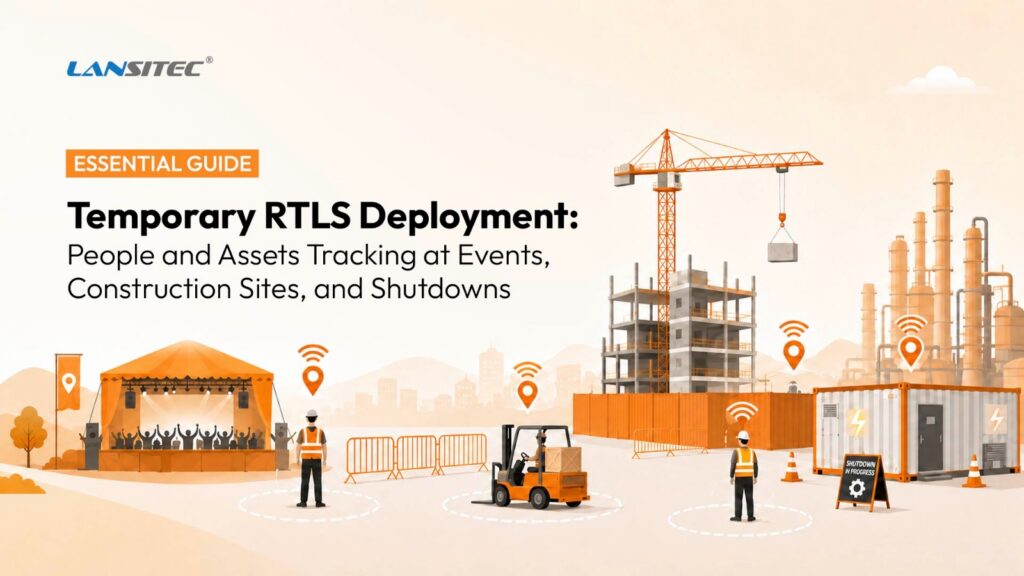
Permanent RTLS gets most of the attention. It has the full site survey, the polished floor plan, the fixed anchors, and the neatly documented installation. That makes sense for a hospital, airport, factory, or warehouse where the same assets move through the same zones for years.
But many tracking problems are temporary. A plant shutdown lasts two weeks. An exhibition runs from Tuesday to Friday. A rental yard changes layout every month. A construction floor may look completely different after scaffolding, partitions, temporary power, and restricted zones are moved.
In those cases, RTLS should act like an operations kit: fast to deploy, clear in purpose, easy to move, and simple to remove when the job ends.
What Is a Temporary RTLS Deployment?
RTLS stands for Real-Time Location System. It is a technology setup that identifies where people, vehicles, tools, equipment, or other assets are within a defined area.
In practice, an RTLS deployment usually combines tags or tracker, portali or anchors, network connectivity, positioning logic, and a map or dashboard. The tracked item carries a tag, badge, helmet sensor, beacon, or asset tracker. The infrastructure receives its signal, estimates its location or zone, and sends that data to the application.
For temporary deployments, RTLS does not always need a full fixed infrastructure. The system can use portable, plug-in, solar-powered, or battery-powered portali to create useful visibility for a specific event, shutdown, rental yard, emergency setup, or construction phase.
Once you define RTLS this way, the planning question becomes simpler: what level of location visibility does this temporary site actually need?
What Problems Does Temporary RTLS Solve?
Temporary RTLS does not need to solve every location problem. It needs to answer the questions that matter during a short, high-pressure phase:
- Is this person, tool, vehicle, container, or badge inside the expected zone?
- When did it enter or leave?
- Where was it last detected?
- Did it cross into a restricted or hazardous area?
- Can we review movement history after the event, shift, or incident?
That last point is often overlooked. The value is not only live tracking. It is also the audit trail.
Temporary RTLS should support the safety and operations plan already in place. Event guidance from the UK Health and Safety Executive focuses on safe site design, crowd movement, entry and exit routes, emergency planning, and evacuation (1)(2). Construction guidance requires a construction phase plan before work begins, including site rules and specific risk measures (3). For turnarounds and maintenance work near covered processes, OSHA’s Process Safety Management standard also includes contractor control requirements (4).
So, temporary RTLS supports an existing safety and operations plan.
For Lansitec, this is exactly where the gateway mix matters. Compact, Micro, Macro, Solar, Indoor, and SocketSync portali each solve a different temporary deployment problem. We’ve seen the best results when customers stop asking, “How do we cover the whole site?” and start asking, “Which zones need visibility for this phase?” Much better question.
How to Choose the Right RTLS Deployment Model
Most Lansitec temporary deployments use one of two patterns.
In B-Mobile, Bluetooth tags or fari move with people or assets, while Gateway Bluetooth stay in known locations. This fits events, tool rooms, rental yards, temporary muster zones, pop-up stores, and short-term medical stations.
In B-Fisso, fari Bluetooth stay fixed while tracker move with workers, vehicles, or assets. This fits construction phases, tunnels, chemical sites, offshore areas, and indoor-outdoor worker tracking.
The choice is practical. Use B-Mobile when you mainly need zone visibility from gateway locations. Use B-Fixed when the moving tracker needs to read known checkpoints and report its own context.
For a three-day exhibition, gateway-based presence may be enough. For a turnaround with hundreds of contractors, temporary work permits, restricted zones, and muster requirements, wearable tracker or helmet sensori may make more sense.
RTLS for Plant Shutdowns and Industrial Turnarounds
During shutdowns and turnarounds, the site changes quickly: contractors arrive, equipment is isolated, scaffolding appears, and temporary stores or workshops open.
Temporary RTLS should focus on controlled visibility:
- who entered a permit-controlled or restricted zone
- which tools, kits, or rescue assets are still inside the area
- whether someone remained in one zone longer than expected
- where a badge or helmet sensor was last detected before an alarm
A practical Lansitec setup might use Badge Tracker or Helmet Sensori for workers, fixed fari Bluetooth at entry points and muster zones, and Macro or Micro Gateway Bluetooth in areas without reliable power. SocketSync portali can support powered indoor zones such as control rooms, temporary offices, workshops, and tool stores, but they should not carry the whole shutdown design.
The point is not to watch dots move for the sake of it, but to reduce blind spots during abnormal work.
For a two-week shutdown, we would usually avoid aggressive reporting everywhere. Use faster reporting in high-risk zones and slower heartbeat intervals in lower-risk areas. LoRaWAN supports low-power wide-area communication and AES-based security features, but airtime and payload design still matter (5). Send events, not noise.
RTLS for Events, Exhibitions, and Temporary Venues
Events are classic temporary RTLS territory. Organizers may need to track demo kits, medical bags, radios, AV equipment, service carts, VIP badges, staff, and visitor flow. Venues rarely behave like permanent smart buildings. Power exists in some places, not others. Walls may be temporary. Storage areas move during build-up and teardown.
For quick indoor coverage, the Lansitec Gateway Bluetooth compatto fits the job well. It is small, portable, uses Bluetooth 5.0 E LoRaWAN, and includes a rechargeable battery for short deployments. For powered indoor areas, SocketSync is even simpler: plug it into AC power and use it near storage cages, registration desks, service corridors, or staff-only rooms.
For outdoor festivals or open-air exhibitions, the Solar Gateway Bluetooth is often the cleaner choice. It combines Bluetooth 5.0 E LoRaWAN, uses a solar panel with a rechargeable battery, and has an IP66 enclosure. No one enjoys running temporary power across a wet outdoor venue unless they absolutely have to.
Event RTLS should map to operational zones: entrances, exits, loading docks, storage rooms, medical points, security points, and high-value demo areas.
Bluetooth’s continued growth in asset tracking and location services also supports this direction. The Bluetooth SIG’s 2025 market update groups asset tracking, Bluetooth LE, direction finding, and location services among active Bluetooth market areas (6). That does not mean every event needs advanced positioning. It means Bluetooth has become a practical foundation for temporary visibility.
RTLS for Construction Site Tracking and Worker Safety
Construction sites punish fixed infrastructure. A good mounting point in March may disappear behind drywall in April. Temporary stairs move. Power availability changes. Metal structures, concrete, people, and machinery all affect radio behavior. RTLS for construction should follow the phase plan.
During early outdoor work, use Solar Gateway Bluetooth around gates, laydown yards, equipment zones, and material storage. During indoor fit-out, Micro Gateway Bluetooth can cover compact or exposed locations without depending on finished electrical infrastructure. In powered temporary offices, tool issue rooms, or welfare units, SocketSync portali can provide stable coverage with minimal setup.
For worker safety, Lansitec’s Helmet Sensor and Badge Tracker add more value than asset tags alone. They support indoor and outdoor tracking logic, and the Helmet Sensor is built for construction and industrial use cases where fall detection, panic alarms, zone alerts, and wearing detection may matter.
One rule matters more than the hardware list: recalibrate when the site changes.
RSSI-based tracking can work well for presence, zone transitions, and rough location estimates, but temporary structures can alter the signal picture. After a floor opens, a barrier moves, or a scaffold comes down, the site team should check gateway placement, beacon locations, RSSI thresholds, and geofence boundaries.
RTLS for Rental Equipment and Temporary Logistics Yards
Rental yards do not usually need centimeter-level positioning. They need fewer lost assets and faster answers.
Where is the pump? Was the generator returned? Did the container move from inspection to dispatch? Which yard zone last detected the pallet cage?
For this, Solar and Macro portali are often the workhorses. Solar portali suit outdoor yards with sunlight and limited wiring. Macro Gateway Bluetooth suit longer temporary phases where power is unavailable, but a rugged battery-powered unit can stay mounted for weeks or months. Compact portali can cover repair bays, dispatch desks, or temporary check-in points.
In rental yards, do not start by chasing exact coordinates. Start with reliable status transitions: received, inspected, staged, dispatched, returned.
That data helps teams act quickly. It also gives managers a cleaner audit trail when equipment goes missing or utilization looks wrong.
RTLS for Emergency Response and Temporary Operations
Emergency RTLS needs the fastest path to useful visibility. You may need to track medical kits, stretchers, radios, temporary stations, evacuation equipment, or staff badges. The site may have limited power. The map may be incomplete. People may not know the building well.
This is where a preconfigured RTLS kit helps. Label the portali. Predefine common zones. Keep spare tags ready. Use simple naming rules. Nobody should invent “Zone A-2 temporary north corridor” during the emergency itself.
A rapid setup could combine Compact portali for indoor zones, SocketSync portali where AC power exists, Solar portali for outdoor staging areas, and badges or wristbands for staff or evacuees when the workflow requires person-level visibility.
It will not replace emergency planning. It will support it with live presence, last-seen data, and movement history.
Choosing the Right BLE Gateway for Temporary RTLS
| Site condition | Vestibilità Lansitec | Perché funziona |
|---|---|---|
| Short indoor event or pop-up zone | Gateway Bluetooth compatto | Portable, rechargeable, quick to place and remove |
| Powered indoor area | Gateway Bluetooth SocketSync | Plug-in AC power, backup battery, simple installation |
| Outdoor area with sunlight | Gateway Bluetooth solare | Solar power, IP66 enclosure, less wiring |
| Longer phase with no power | Gateway Bluetooth macro | Large battery, rugged enclosure, long-duration use |
| Compact exposed location | Micro gateway Bluetooth | Small IP68 gateway for difficult or rugged spots |
| Worker tracking across changing zones | Tracker dei badge O Sensore del casco | Better fit for personnel movement, alerts, and safety workflows |
Power planning should happen before placement. Mark each gateway location as reliable AC power, uncertain power, or no power. Use SocketSync or Indoor gateways for reliable power; Compact where power is temporary, or backup is needed; and Solar, Macro, or Micro where wiring is unavailable.
This sounds basic, but it is also where many projects either run smoothly or start wasting time.
How Accurate Is Temporary RTLS?
BLE RSSI is strong for rilevamento di presenza, zone alerts, entry and exit logs, and last-seen location. It can also support rough location with multiple portali O fari. Lansitec’s B-Mobile and B-Fixed approaches use RSSI, known gateway or beacon positions, and map logic to estimate location, but RSSI cannot magically remove the effects of walls, metal, multipath, moving crowds, or changing layouts.
For a shutdown, knowing that a contractor entered the wrong unit may matter more than plotting them to 30 cm. For an exhibition, knowing that a demo kit moved from Booth A to the loading dock may be enough. For construction, knowing that a helmet sensor is inside a hazardous zone can support a faster response.
Use the accuracy level that matches the decision.
Temporary RTLS Deployment Checklist
Before the temporary phase starts, confirm four things:
- Duration: two days, two weeks, or six months?
- Tracking target: people, assets, vehicles, tools, or zones?
- Required result: presence, history, alerts, or coordinates?
- Power and ownership: who powers, checks, moves, and updates the system?
Then define the exit plan. Temporary RTLS should leave something behind: an incident timeline, movement history, utilization report, or a better plan for the next shutdown.
Best Practices for Temporary RTLS Deployments
A temporary RTLS deployment can be simple. It should not be casual.
Events still need crowd and emergency planning. Construction phases still need site rules and risk controls. Shutdowns and turnarounds still need contractor visibility and safe entry and exit processes.
RTLS supports those processes by showing who is where, what moved, what crossed a boundary, and what happened during the shift.
Lansitec’s gateway range makes this easier because the infrastructure does not need to look the same everywhere. Use SocketSync where power is easy. Use Compact where the setup is short. Use Solar outdoors. Use Macro or Micro where power is missing, but the phase lasts longer. Pair them with BLE fari, labels, badges, helmet sensori, or asset tracker, depending on what needs to move.
Permanent RTLS is a building project. Temporary RTLS is an operations tool. Planned well, it can be deployed, trusted, moved, and removed before a permanent project would have finished its first survey.
Domande frequenti
About Temporary RTLS Deployments
Can RTLS be deployed temporarily?
Yes. RTLS does not always require permanent anchors, cabling, or a full building-wide installation. For temporary sites, the system can use portable, plug-in, solar-powered, or battery-powered portali to cover the zones that matter during a specific event, shutdown, turnaround, rental period, or construction phase.
What is the best RTLS setup for a two-week shutdown?
For a two-week shutdown, start with the risk zones. Use wearable tracker or helmet sensori for workers and contractors, then place fari Bluetooth O portali at entrances, muster points, permit-controlled areas, tool stores, and temporary workshops. Battery-powered Macro or Micro portali help where power is unavailable, while SocketSync portali fit powered indoor areas.
Is BLE accurate enough for temporary asset tracking?
BLE is usually accurate enough for rilevamento di presenza, zone tracking, entry and exit logs, and last-seen asset location. It is not the right tool if the project needs centimeter-level positioning in every zone. For many temporary deployments, knowing that an asset moved from storage to dispatch is more useful than plotting its exact coordinates.
How should RTLS be planned for a changing construction site?
Plan RTLS around the current construction phase, not the final building layout. Mark gates, laydown yards, hazardous zones, temporary offices, material stores, and access routes. Then update gateway placement, beacon locations, RSSI thresholds, and geofences whenever walls, scaffolding, floors, or work zones change.

 English
  ไทย
ไทย  한국어
한국어  Français
  Deutsch
  Español
  日本語
日本語  العربية
  Italiano
  Português