NTN at a Glance
NTN (Non-Terrestrial Networks) is 3GPP’s standardized way to extend mobile connectivity beyond terrestrial cell towers, using satellites and other non-ground platforms. In plain terms, it is how tracking devices keep reporting when the asset is far from any usable terrestrial network. (1)
NTN shines when:
- You track in remote or infrastructure-limited regions (pastures, mountains, sea routes)
- You need a “last resort” bearer that still delivers small messages
- You want one backend experience, even when the bearer changes (cellular today, satellite tomorrow) (2)
What problem does NTN solve? for tracking
Tracking fails in the gaps. Not because the device is “offline”, but because coverage is uneven, and the last 5 percent of your route is often the most crucial part.
Your tracker only needs to send small messages, but it needs to do it reliably, even when LTE-M or NB-IoT is missing, and even when your LoRaWAN gateways are miles away. Hybrid terrestrial + NTN is an advantageous approach, and GSMA explicitly frames NTN as a complement to terrestrial networks, not a replacement. (2)
We see this pattern a lot in real deployments: animals move past the last tower, assets cross borders and roaming becomes messy, or sites are temporary (events, seasonal farms, pop-up yards).
NTN is the practical answer when you cannot justify building infrastructure (like installing gateways), but you still need periodic proof-of-life and location reporting.
How does NTN (Non-Terrestrial Networks) work?
NTN is still “cellular thinking”, just with a satellite in the link.
A tracking device: Collects position (typically GNSS) > Builds a small payload (location, state, alarms) > Sends it over an NTN link to a satellite access node > Routes back into the operator and your IoT backend (similar to how cellular does it) (1)
Satellite bands (FR1 NTN): 3GPP introduced new NTN bands n255 (L-band) and n256 (S-band), and ETSI TS 38.108 lists their uplink and downlink ranges.
Important reality check: satellite links bring longer propagation delays and higher Doppler than terrestrial links, especially with LEO constellations; that is normal. That is why NTN tracking designs usually prefer short payloads, smart scheduling with tuned report intervals, and careful power planning with event-based alerts. (3)
LEO (Low Earth Orbit) vs GEO (Geostationary Orbit) for tracking
NTNs are networks or segments of networks that use either Uncrewed Aircraft Systems (UAS) or satellites in different constellations to carry transmission equipment, such as a relay node or base station.
In the NTN tracking world, there are four options for “where is the satellite flying,” and those choices show up as latency, Doppler, and how often your device can see a satellite.
- Low Earth Orbit (LEO): Circular orbit in altitudes of typ. 500-2.000km (lower delay and better link budget, but a larger number of satellites needed for coverage)
- Medium Earth Orbit (MEO): Circular orbit in altitudes of typ. 8.000-20.000km
- Geostationary Earth Orbit (GEO): Circular orbit 35.786 km above the Earth’s equator (Note: Due to gravitational forces, a GEO satellite is still moving within a range of a few km around its nominal orbital position).
- Highly Elliptical Orbiting (HEO): Elliptical orbit around the Earth. (1)
Typically, for tracking, LEO and GEO are the most popular options because of their characteristics. You do not need all the math, but you do need the trade-off.
- LEO (Low Earth Orbit): moving satellites, fast-changing radio conditions, better “responsiveness” in many cases, but Doppler matters.
- GEO (Geostationary Orbit): more static geometry, typically higher delay, best for periodic messaging and “just get it through” updates.
Why is NTN (Non-Terrestrial Networks) different?
Coverage comes first.
NTN exists because terrestrial networks have edges, and those edges are а business risk.
Hybrid is the winning pattern.
Most tracking deployments do not run satellite 24/7. They use terrestrial bearers when available, and switch to NTN only when needed. GSMA explicitly discusses hybrid cellular/NTN approaches for IoT. (2)
Bands are standardized.
3GPP specifies dedicated satellite operating bands in FR1 NTN such as n255 and n256, with uplink and downlink ranges defined in ETSI TS 38.108. (4)
NTN vs LTE-M / NB-IoT / LoRaWAN for tracking
| Question you care about | NTN | LTE-M / NB-IoT | LoRaWAN |
|---|---|---|---|
| Works with no local infrastructure | Yes (satellite) | Only if there is operator coverage | Only if you have gateways or a public LoRaWAN network |
| Best for | Remote fallback, coverage gaps | Routine reporting where cellular exists | Private or wide-area LPWAN where you control gateway placement |
| Typical payload mindset | Small, scheduled, exception-driven | Small to medium, more frequent possible | Small, airtime-aware |
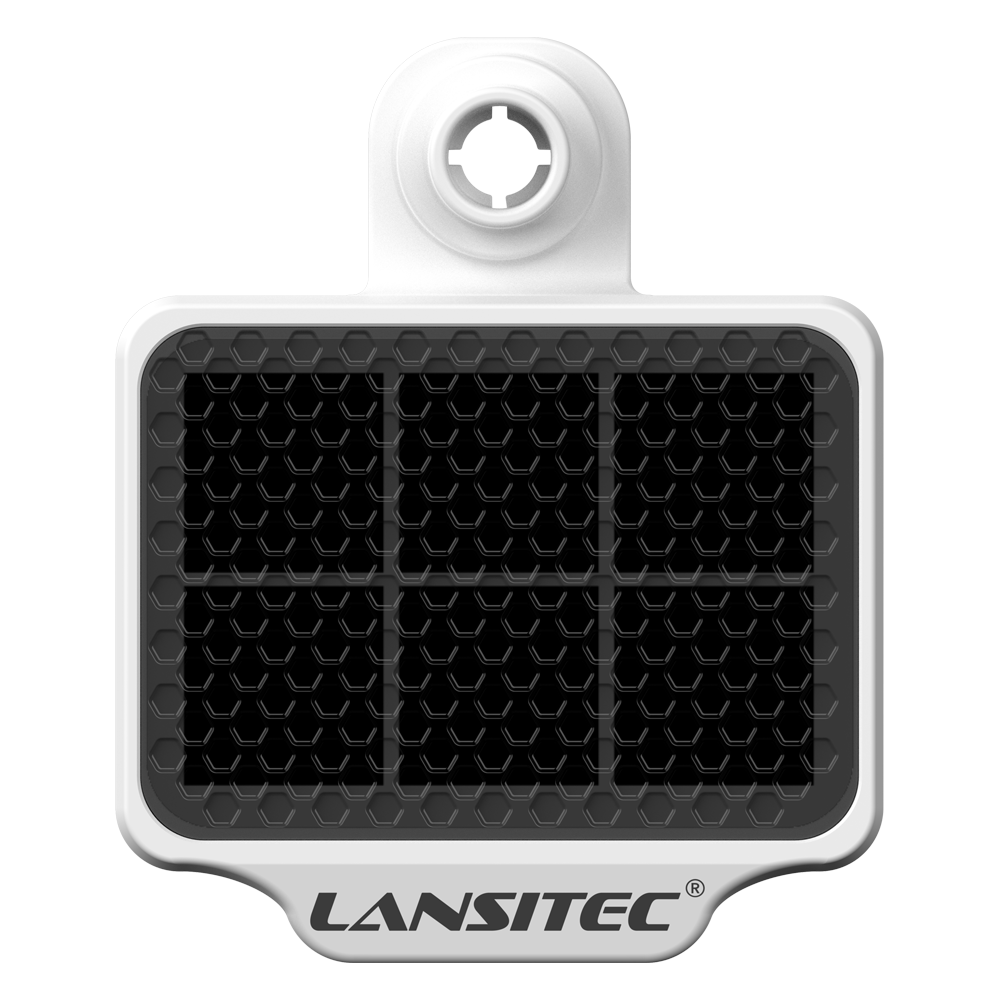
Lansitec NTN device: NTN Livestock Tracking Tag
This is the clean example of how NTN should be used in tracking: multi-network by design, not satellite-only.
NTN Livestock Tracking Tag – LoRaWAN Ear Tags For Cattle – Lansitec
| Connectivity snapshot (from our catalog) | Tracking functions (practical features buyers ask about) | Power and ruggedness (the field reality) |
|---|---|---|
| NTN: n255/n256, with listed peak rates for LEO and GEOLTE-M + NB-IoT + LoRaWAN in the same device for hybrid operationSIM: Nano SIM or eSIM | Geo-fence support and alarm supportConfigurable report intervals (heartbeat, GNSS, Bluetooth)FOTA over Bluetooth support | 500 mAh rechargeable battery + integrated solar panelIP66 ingress protectionGNSS accuracy listed as <2.5 m (CEP50) |
Frequently Asked Questions
About NTN (Non-Terrestrial Networks) for Tracking
Is NTN “real cellular” or a proprietary satellite link?
In this context, NTN refers to 3GPP standardized non-terrestrial networks that integrate satellite and other non-ground platforms into the mobile ecosystem. (1)
References and further reading: