
How to Check Water Pump Status Remotely Without Site Visits
Out in the field, “Is the pump running?” sounds like a tiny question… until you’ve got 30 pumps spread across farms, canals, or wellheads. Then it turns into daily windshield time, fuel, and missed failures.
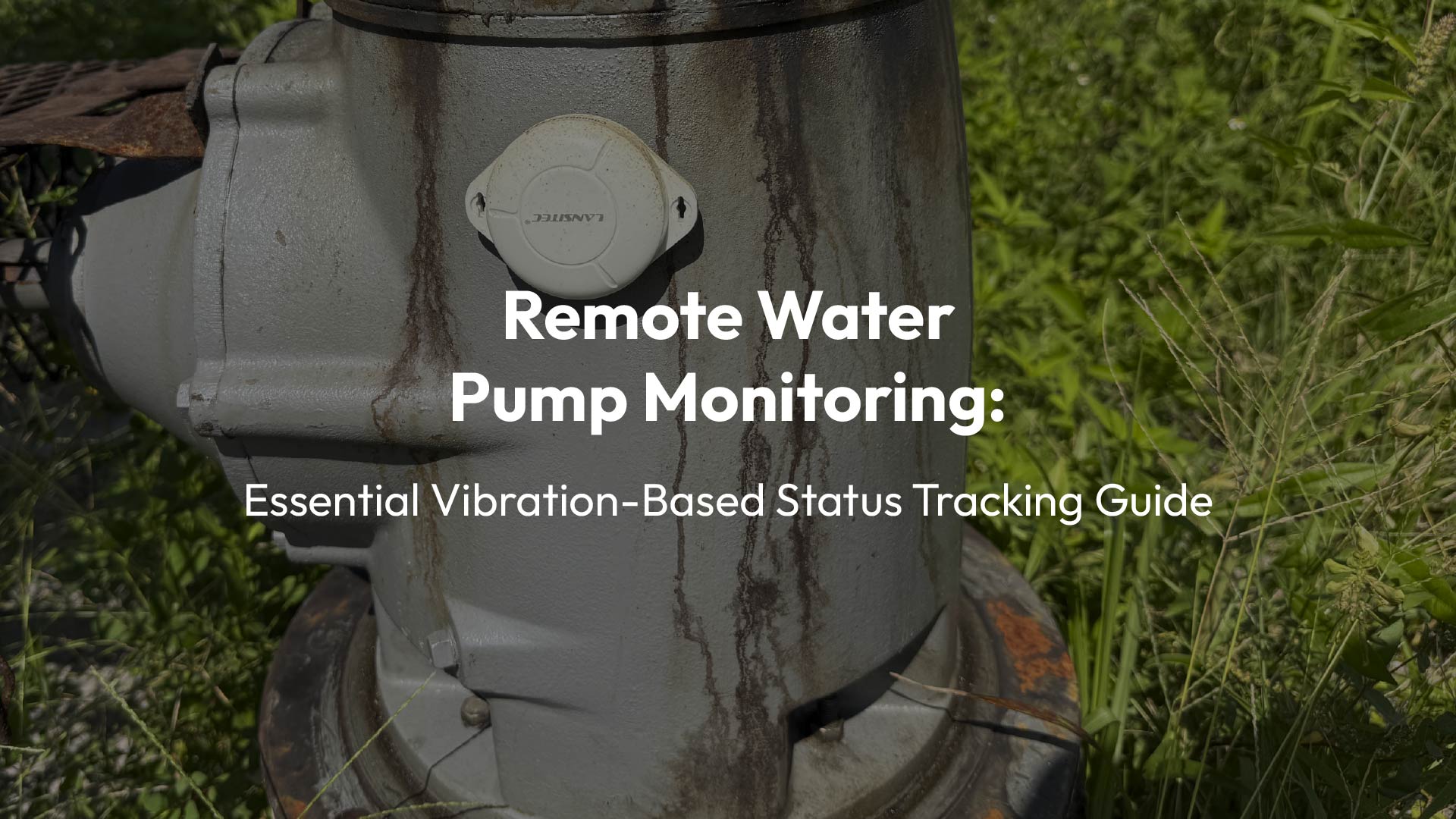
We recently helped a customer mount a Bluetooth beacon on water pump-type machines and use vibration to infer operating status. Simple logic. Big impact. When vibration is detected, the machine is running. When there’s no vibration, it’s stopped or possibly stuck. And the best part: no one has to drive around just to check. They open a phone or laptop dashboard instead.
Simple Concept: Detect Pump Running Status Using Vibration
Use a Bluetooth beacon with a built-in 3D accelerometer to broadcast “movement present” vs “no movement,” then let a Solar Bluetooth Gateway collect that data and push it to the cloud. From there, it’s alerts and dashboards. Clean and practical.
Remote Water Pump Monitoring System Architecture (Off-Grid Ready)
| Layer | What you deploy | What it does |
|---|---|---|
| On the machine | Bluetooth beacon/tag with 3D accelerometer (example: Lansitec i3 Portable Bluetooth Tag) | Detects movement and can dynamically report movement data in its BLE advertising payload. [2] |
| At the site | NB-IoT/LTE-M Solar Bluetooth Gateway | Scans for nearby BLE advertisements and forwards selected payload bytes to the server via cellular, powered by solar + battery. [1] |
| In your app/platform | Dashboard + rules | Converts “vibration seen” into Running, Stopped, and Alarm states, with notifications. |
How Vibration-Based Pump Monitoring Works in the Field
- Where to Mount a Vibration Sensor on a Water Pump
Usually, that’s the motor housing or a rigid bracket that vibrates when the pump runs. Not the loose guard that rattles in the wind. - Mount the solar gateway nearby with a decent sky view.
The Lansitec NB-IoT/LTE-M Solar Bluetooth Gateway is built for exactly this kind of outdoor, no-power location. It supports iBeacon, Eddystone, and custom Bluetooth protocols, and it’s in an IP66 enclosure. Power-wise, it pairs a 3 W solar panel with a 5300 mAh Li-ion rechargeable battery. - Turn vibration into a status timeline.
At the platform level, you typically implement a tiny state machine:- If “movement” frames are seen in the last X minutes, set Running.
- If nothing is seen for Y minutes, set Stopped.
- If it should be running (schedule) but is stopped, raise Alarm.
That’s it. No DSP thesis required.
Why Vibration Is a Reliable Signal for Pump Running Detection
In industrial monitoring, accelerometers are a standard tool for measuring vibration signatures and detecting operating behavior. We’re simply using a lightweight version of that concept for run-status, not full predictive maintenance.
Real-World Deployment Tips for Remote Pump Monitoring
- Pick the right beacon for the job. If you want vibration or motion, use a tag/beacon designed to report movement data. The i3 tag’s built-in 3D accelerometer triggers movement-based advertising and supports multiple frames, so you can broadcast both ID and motion state.
- Tune intervals for “fast enough” alerts. The gateway supports adjustable reporting intervals, and its battery life depends on how often it scans and reports. Lansitec even publishes an example operating point: 1 month at 10 s Bluetooth receiving duration and 60 s report interval (useful as a sanity check when you’re configuring).
- Avoid false “Stopped” due to RF shadows. Metal frames and engine blocks can block BLE. If a pump is inside a shed or behind steel, move the gateway a bit higher or change the antenna placement.
Frequently Asked Questions
About Remote Water Pump Monitoring Status with Vibration
Can this detect “fault” or only “running or stopped”?
The basic version is run or stop. You can add fault heuristics later, like “runs shorter than normal” or “unexpected stops,” once you’ve collected a few weeks of baseline history.
How many pumps can one gateway cover?
It depends on RF conditions and how chatty your beacons are. In open areas, you’ll often get strong line-of-sight coverage. Lansitec’s beacon specs commonly reference up to 150 m line-of-sight for compatible gateways (real sites vary). Depending on various factors, up to 105 beacons can be supported by a single gateway.
Do I need mains power at the pump?
No, that’s the whole point. The Solar Bluetooth Gateway is designed for off-grid deployments with solar + battery.
What if the pump vibrates lightly or intermittently?
Set a slightly longer decision window. Instead of “no vibration for 2 minutes = stopped,” try 5 to 10 minutes. It keeps alerts meaningful, not noisy.






 English
  ไทย
ไทย  한국어
한국어  Français
  Deutsch
  Español
  日本語
日本語  العربية
  Italiano
  Português